a scientist hypothesized that oxygen atoms from both carbon dioxide and water are used to make glucose…
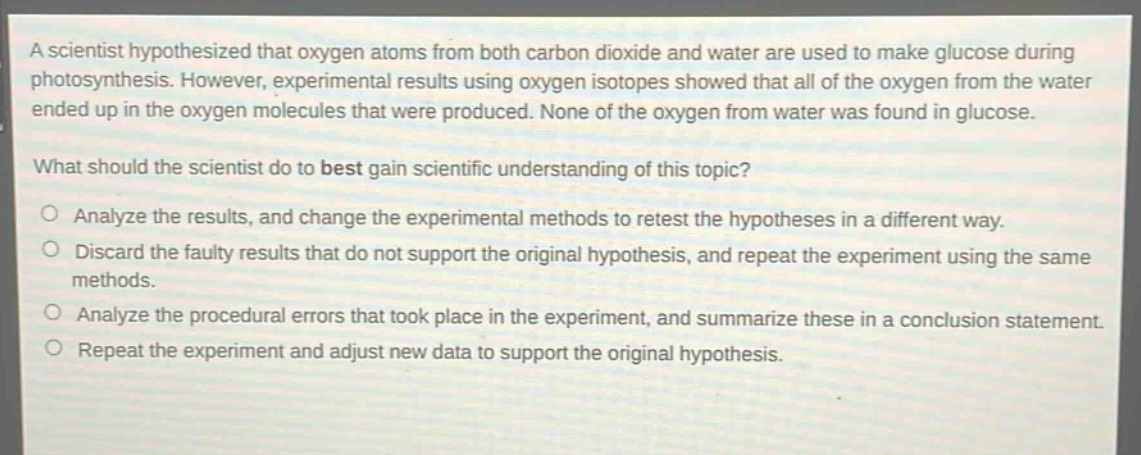
a scientist hypothesized that oxygen atoms from both carbon dioxide and water are used to make glucose during photosynthesis. however, experimental results using oxygen isotopes showed that all of the oxygen from the water ended up in the oxygen molecules that were produced. none of the oxygen from water was found in glucose.\nwhat should the scientist do to best gain scientific understanding of this topic?\n○ analyze the results, and change the experimental methods to retest the hypotheses in a different way.\n○ discard the faulty results that do not support the original hypothesis, and repeat the experiment using the same methods.\n○ analyze the procedural errors that took place in the experiment, and summarize these in a conclusion statement.\n○ repeat the experiment and adjust new data to support the original hypothesis.
Answer
Brief Explanations:
In scientific research, when results contradict a hypothesis, the proper approach is to analyze the results. Changing experimental methods to retest hypotheses in a different way can lead to a better understanding. Discarding results that don't support the hypothesis (as in option 2) is unethical. Just summarizing procedural errors (option 3) without further testing is insufficient. Adjusting data to support the hypothesis (option 4) is also unethical.
Answer:
A. Analyze the results, and change the experimental methods to retest the hypotheses in a different way.