1. a scientist records the number of bacteria in a petri dish at several times of the day in this…
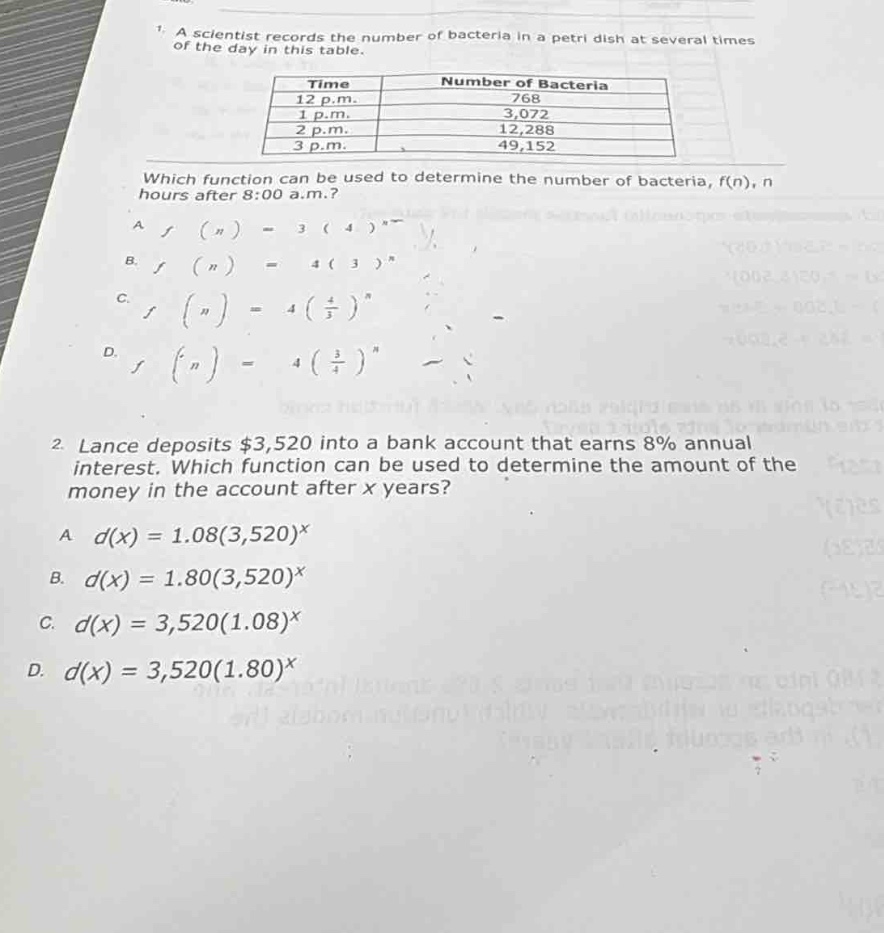
1. a scientist records the number of bacteria in a petri dish at several times of the day in this table.\n|time|number of bacteria|\n|----|----|\n|12 p.m.|768|\n|1 p.m.|3,072|\n|2 p.m.|12,288|\n|3 p.m.|49,152|\nwhich function can be used to determine the number of bacteria, f(n), n hours after 8:00 a.m.?\na (f(n)=3(4)^{n - 4})\nb. (f(n)=4(3)^{n})\nc. (f(n)=4(\frac{4}{3})^{n})\nd. (f(n)=4(\frac{3}{4})^{n})\n2. lance deposits $3,520 into a bank account that earns 8% annual interest. which function can be used to determine the amount of the money in the account after x years?\na (d(x)=1.08(3,520)^{x})\nb. (d(x)=1.80(3,520)^{x})\nc. (d(x)=3,520(1.08)^{x})\nd. (d(x)=3,520(1.80)^{x})
Answer
Answer:
- A. (f(n)=3(4)^{n - 4})
- C. (d(x)=3520(1.08)^{x})
Explanation:
Step1: Analyze bacteria - growth problem
Let (n) be the number of hours after 8:00 a.m. At 12 p.m. ((n = 4)), (f(4)=768). At 1 p.m. ((n = 5)), (f(5)=3072). The general form of an exponential - growth function is (y = a(b)^{n}). First, find the common ratio (b). (\frac{f(5)}{f(4)}=\frac{3072}{768}=4). When (n = 4), (y = 768). Substitute into (y=a(b)^{n}), (768=a(4)^{4}), (a = 3). So the function is (f(n)=3(4)^{n - 4}).
Step2: Analyze compound - interest problem
The formula for compound interest is (A = P(1 + r)^{t}), where (P) is the principal amount, (r) is the annual interest rate (as a decimal), and (t) is the number of years. Here, (P = 3520), (r=0.08), and (t = x). Substituting these values into the formula, we get (d(x)=3520(1 + 0.08)^{x}=3520(1.08)^{x}).