a scientist writes the equation $n(h)=100e^{0.25h}$ to model the growth of a certain bacteria in a petri…
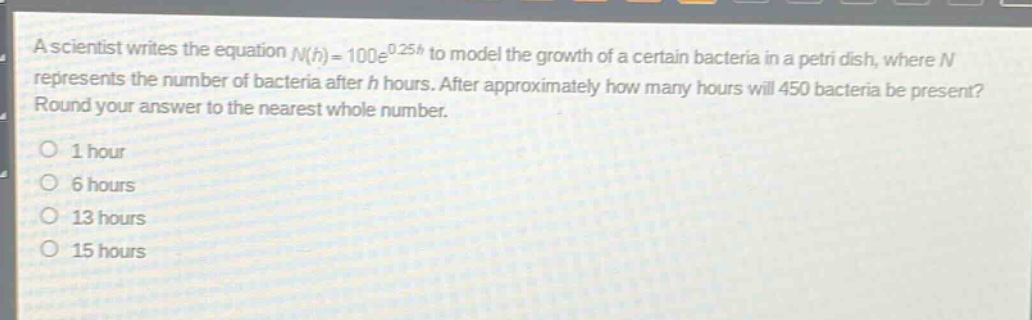
a scientist writes the equation $n(h)=100e^{0.25h}$ to model the growth of a certain bacteria in a petri dish, where $n$ represents the number of bacteria after $h$ hours. after approximately how many hours will 450 bacteria be present? round your answer to the nearest whole number.\n1 hour\n6 hours\n13 hours\n15 hours
Answer
Explanation:
Step1: Set up the equation
Set $N(h)=450$ in the equation $N(h)=100e^{0.25h}$, so we have $450 = 100e^{0.25h}$.
Step2: Simplify the equation
Divide both sides by 100: $\frac{450}{100}=e^{0.25h}$, which simplifies to $4.5 = e^{0.25h}$.
Step3: Take the natural - logarithm of both sides
$\ln(4.5)=\ln(e^{0.25h})$. Since $\ln(e^{x}) = x$, we get $\ln(4.5)=0.25h$.
Step4: Solve for h
$h=\frac{\ln(4.5)}{0.25}$. We know that $\ln(4.5)\approx1.504077$, so $h=\frac{1.504077}{0.25}=6.016308\approx6$.
Answer:
6 hours