why are scientists concerned about the use of the bt toxin, which is used to kill insects, in genetic…
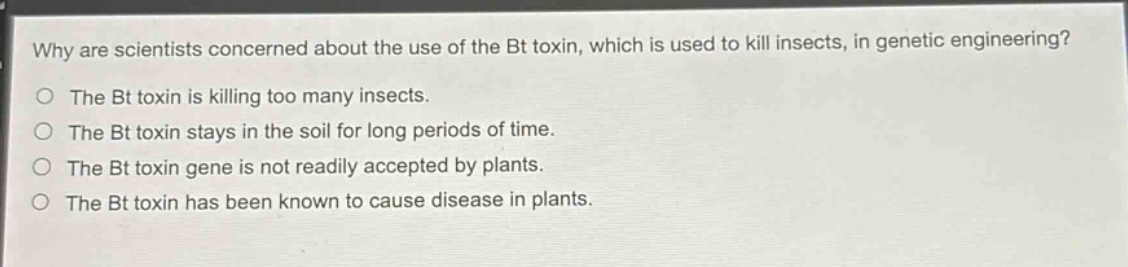
why are scientists concerned about the use of the bt toxin, which is used to kill insects, in genetic engineering?\nthe bt toxin is killing too many insects.\nthe bt toxin stays in the soil for long periods of time.\nthe bt toxin gene is not readily accepted by plants.\nthe bt toxin has been known to cause disease in plants.
Answer
Brief Explanations:
The Bt toxin is a protein produced by the bacterium Bacillus thuringiensis. When used in genetic engineering, one of the main concerns is its environmental persistence. The Bt toxin can remain in the soil for long periods. This can have various ecological impacts, such as affecting non - target soil organisms.
- The first option is incorrect because the goal of using Bt toxin in pest control (including in genetic engineering applications) is to kill pest insects. While non - target effects are a concern, “killing too many insects” is a rather vague statement compared to the more specific environmental persistence issue.
- The third option is incorrect. The Bt toxin gene can be successfully incorporated into plant genomes (for example, in Bt cotton, Bt corn etc.), and plants can express the Bt toxin protein.
- The fourth option is incorrect. The Bt toxin is targeted at insects (specifically, it binds to receptors in the insect mid - gut and causes cell lysis and death). There is no evidence to suggest that it causes disease in plants.
Answer:
The Bt toxin stays in the soil for long periods of time.