select the correct answer.\nin chickens, a flat single comb is a recessive trait, while the short, thick…
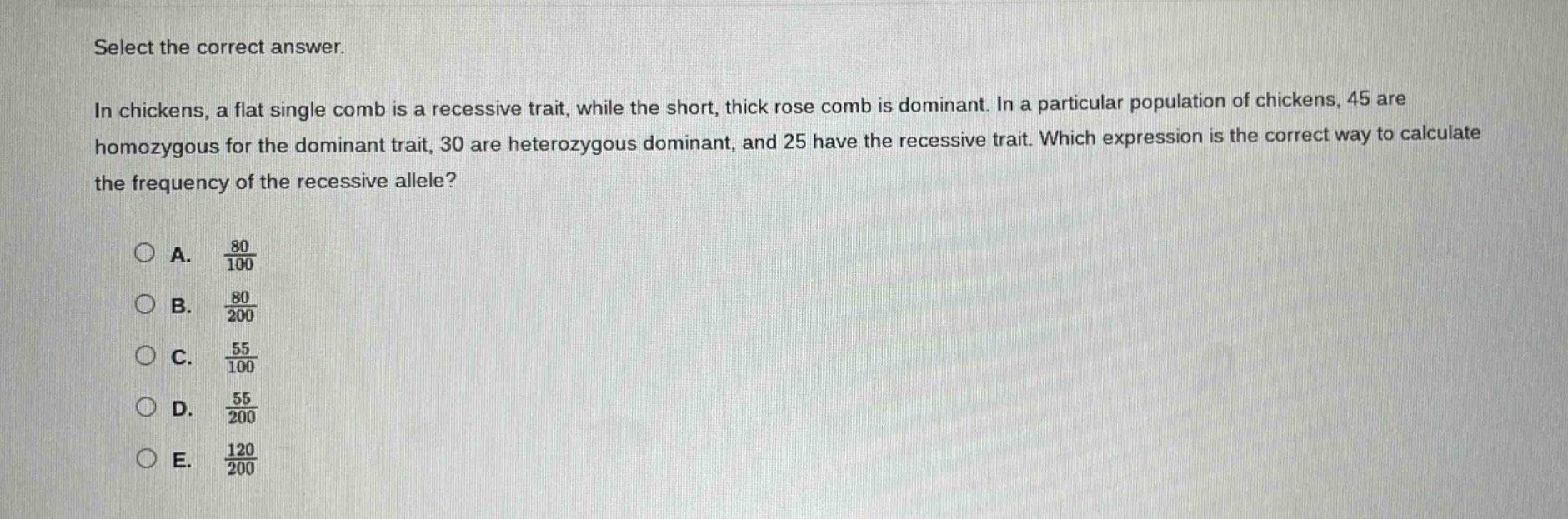
select the correct answer.\nin chickens, a flat single comb is a recessive trait, while the short, thick rose comb is dominant. in a particular population of chickens, 45 are homozygous for the dominant trait, 30 are heterozygous dominant, and 25 have the recessive trait. which expression is the correct way to calculate the frequency of the recessive allele?\na. $\frac{80}{100}$\nb. $\frac{80}{200}$\nc. $\frac{55}{100}$\nd. $\frac{55}{200}$\ne. $\frac{120}{200}$
Answer
Explanation:
Step1: Calculate total number of alleles
The total number of chickens is (45 + 30+25=100). Since each chicken has 2 alleles for the trait, the total number of alleles in the population is (100\times2 = 200).
Step2: Count number of recessive alleles
Homo - recessive individuals ((25)) have 2 recessive alleles each ((25\times2 = 50)), and heterozygous individuals ((30)) have 1 recessive allele each ((30\times1=30)). The total number of recessive alleles is (50 + 30=80).
Step3: Calculate frequency of recessive allele
The frequency of the recessive allele is the number of recessive alleles divided by the total number of alleles, so it is (\frac{80}{200}).
Answer:
B. (\frac{80}{200})