the size of a cell is typically found by capturing an image under a microscope then using software to…
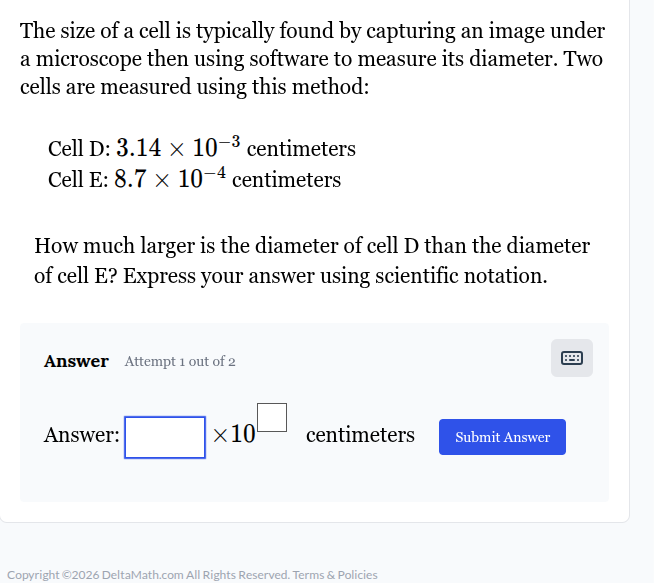
the size of a cell is typically found by capturing an image under a microscope then using software to measure its diameter. two cells are measured using this method: cell d: $3.14 \\times 10^{-3}$ centimeters cell e: $8.7 \\times 10^{-4}$ centimeters how much larger is the diameter of cell d than the diameter of cell e? express your answer using scientific notation. answer attempt 1 out of 2 answer: \\(\\square \\times 10^{\\square}\\) centimeters submit answer
Answer
Explanation:
Step1: Make exponents same
To subtract the two numbers in scientific notation, we first make the exponents of (10) the same. We know that (3.14\times 10^{-3}=31.4\times 10^{-4}) (since moving the decimal point one place to the right in (3.14) and decreasing the exponent of (10) by (1) keeps the value the same).
Step2: Subtract the coefficients
Now we subtract the coefficient of cell E from the coefficient of cell D (after adjusting exponents). So, (31.4\times 10^{-4}- 8.7\times 10^{-4}=(31.4 - 8.7)\times 10^{-4}). Calculating (31.4-8.7 = 22.7)? Wait, no, wait (31.4 - 8.7=22.7)? Wait, no, (31.4-8.7 = 22.7)? Wait, no, (31.4 - 8.7=22.7)? Wait, no, I made a mistake. Wait (3.14\times 10^{-3}=31.4\times 10^{-4}), then (31.4\times 10^{-4}-8.7\times 10^{-4}=(31.4 - 8.7)\times 10^{-4}=22.7\times 10^{-4})? Wait, no, that's not correct. Wait, no, (3.14\times 10^{-3}=3.14\times\frac{1}{1000} = 0.00314), (8.7\times 10^{-4}=0.00087). Then (0.00314 - 0.00087=0.00227). Now, converting (0.00227) to scientific notation: we move the decimal point 3 places to the right to get (2.27) and the exponent of (10) is (- 3) (since we moved the decimal point 3 places to the right, the exponent is (-3)). Wait, let's do it properly. Let's start over.
Correct Step1: Rewrite both numbers with the same exponent. Let's use exponent (-3) for cell E. (8.7\times 10^{-4}=0.87\times 10^{-3}) (since moving the decimal point one place to the left in (8.7) and increasing the exponent of (10) by (1) gives (0.87\times 10^{-3})).
Correct Step2: Subtract the coefficients. Now, (3.14\times 10^{-3}-0.87\times 10^{-3}=(3.14 - 0.87)\times 10^{-3}). Calculating (3.14 - 0.87 = 2.27). So the result is (2.27\times 10^{-3}).
Wait, let's check with the decimal values. (3.14\times 10^{-3}=0.00314), (8.7\times 10^{-4}=0.00087). (0.00314-0.00087 = 0.00227). Now, (0.00227) in scientific notation is (2.27\times 10^{-3}) (because we move the decimal point 3 places to the right to get a number between 1 and 10, so the exponent is (-3)).
Wait, where did I go wrong earlier? When I converted (3.14\times 10^{-3}) to (31.4\times 10^{-4}), then subtracting (8.7\times 10^{-4}) gives (22.7\times 10^{-4}), which is equal to (2.27\times 10^{-3}) (since (22.7\times 10^{-4}=2.27\times 10^{-3}) by moving the decimal point one place to the left in (22.7) and increasing the exponent of (10) by (1)). Yes, that's correct. So (22.7\times 10^{-4}=2.27\times 10^{-3}).
So the correct subtraction is:
We have cell D: (3.14\times 10^{-3}) cm, cell E: (8.7\times 10^{-4}) cm.
Convert cell E to exponent (-3): (8.7\times 10^{-4}=0.87\times 10^{-3}) (because (10^{-4}=10^{-3 - 1}=\frac{10^{-3}}{10}), so (8.7\times 10^{-4}=\frac{8.7}{10}\times 10^{-3}=0.87\times 10^{-3})).
Then, (3.14\times 10^{-3}-0.87\times 10^{-3}=(3.14 - 0.87)\times 10^{-3}=2.27\times 10^{-3}).
Answer:
(2.27\times 10^{-3}) centimeters, so the first box is (2.27) and the second box is (-3).