why do species evolve during adaptive radiation?\n to fill different niches\n to create variation\n to…
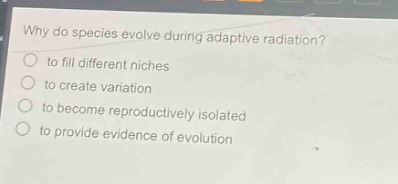
why do species evolve during adaptive radiation?\n to fill different niches\n to create variation\n to become reproductively isolated\n to provide evidence of evolution
Answer
Answer:
A. to fill different niches
Brief Explanations:
Adaptive radiation is a process where organisms diversify rapidly into a variety of new forms. This occurs mainly to fill different ecological niches. When new habitats or resources become available (such as after a mass - extinction event or the formation of new islands), species evolve different traits (morphological, physiological, behavioral) to exploit these niches. For example, Darwin's finches on the Galapagos Islands evolved different beak shapes to eat different types of food (insects, seeds of different sizes etc.), each beak shape being adapted to a specific niche.
Option B is incorrect because while variation is a prerequisite for adaptive radiation (as it provides the raw material for natural selection), the evolution during adaptive radiation is not for the purpose of creating variation. Variation is already present due to genetic mutations, recombination etc.
Option C is incorrect. Reproductive isolation is a mechanism that can lead to speciation (a result of adaptive radiation in some cases), but it is not the purpose of species evolving during adaptive radiation.
Option D is incorrect. While the patterns of adaptive radiation can be used as evidence of evolution (showing how species have diverged from a common ancestor), this is not the reason for species to evolve during adaptive radiation. The driving force is ecological - to exploit different resources and habitats (niches).