which statement does not support the endosymbiotic theory?\no mitochondria and chloroplasts reproduce…
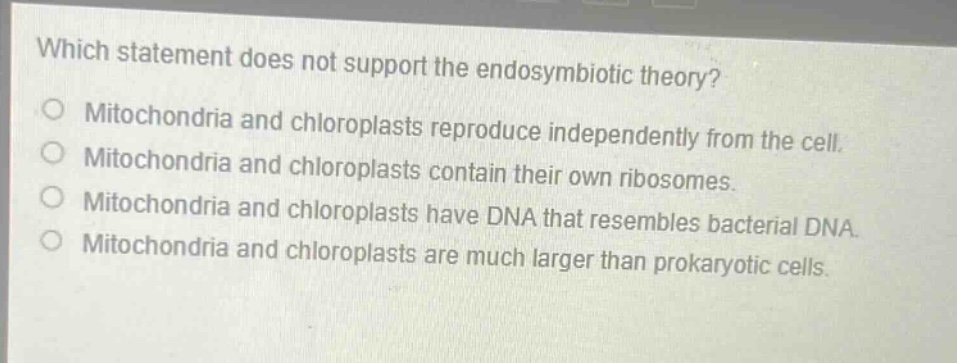
which statement does not support the endosymbiotic theory?\no mitochondria and chloroplasts reproduce independently from the cell.\no mitochondria and chloroplasts contain their own ribosomes.\no mitochondria and chloroplasts have dna that resembles bacterial dna.\no mitochondria and chloroplasts are much larger than prokaryotic cells.
Answer
Brief Explanations:
The endosymbiotic theory posits that mitochondria and chloroplasts were once free - living prokaryotes that were engulfed by a host cell. Features like independent reproduction, having their own ribosomes, and having DNA similar to bacterial DNA support this theory. However, mitochondria and chloroplasts being much larger than prokaryotic cells goes against the idea that they were once prokaryotes.
Answer:
Mitochondria and chloroplasts are much larger than prokaryotic cells.