study the table.\nnumber of amino acid differences in cytochrome c for five species\n| | wild horse | black…
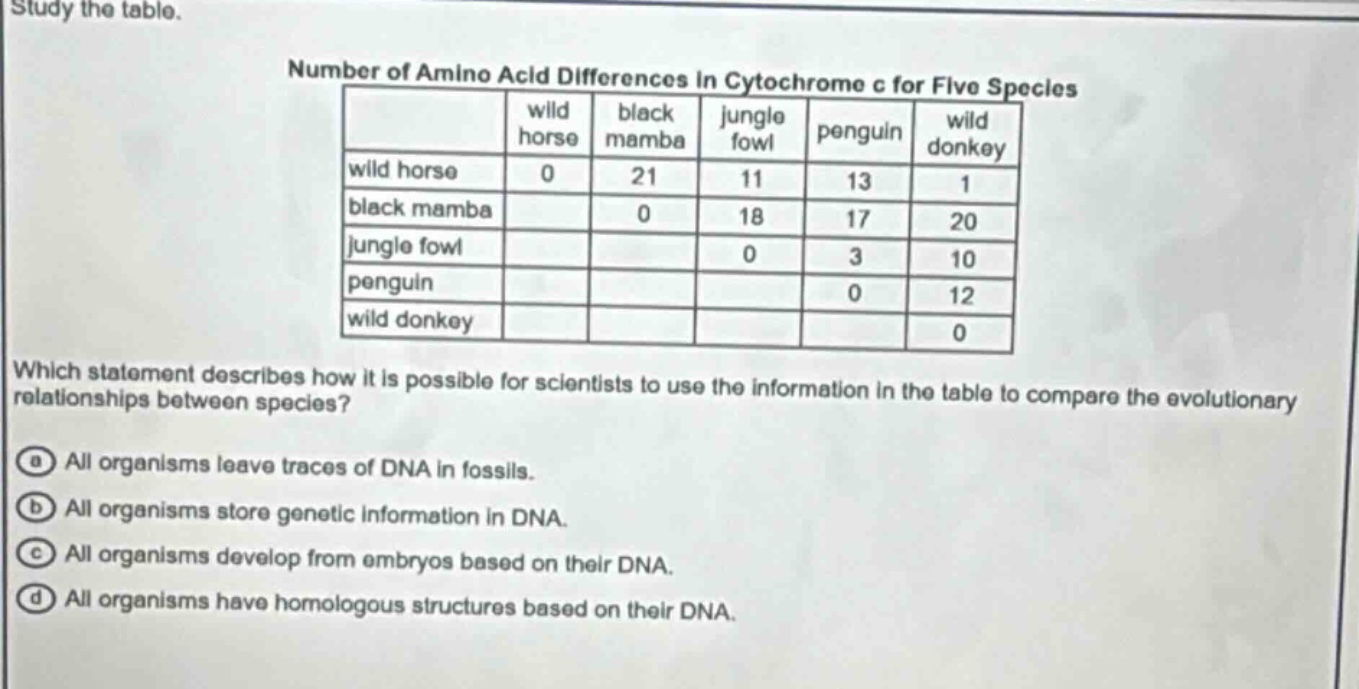
study the table.\nnumber of amino acid differences in cytochrome c for five species\n| | wild horse | black mamba | jungle fowl | penguin | wild donkey |\n|--|--|--|--|--|--|\n| wild horse | 0 | 21 | 11 | 13 | 1 |\n| black mamba | | 0 | 18 | 17 | 20 |\n| jungle fowl | | | 0 | 3 | 10 |\n| penguin | | | | 0 | 12 |\n| wild donkey | | | | | 0 |\nwhich statement describes how it is possible for scientists to use the information in the table to compare the evolutionary relationships between species?\n(a) all organisms leave traces of dna in fossils.\n(b) all organisms store genetic information in dna.\n(c) all organisms develop from embryos based on their dna.\n(d) all organisms have homologous structures based on their dna.
Answer
Brief Explanations:
Scientists can compare evolutionary relationships by looking at genetic information stored in DNA. Cytochrome c is a protein whose amino - acid sequence is determined by DNA. Since all organisms store genetic information in DNA, differences in the amino - acid sequence of cytochrome c can be used to infer evolutionary relatedness.
Answer:
b. All organisms store genetic information in DNA.