synthesis\n15. charles darwin published his book on the origin of species in 1859. of the different types of…
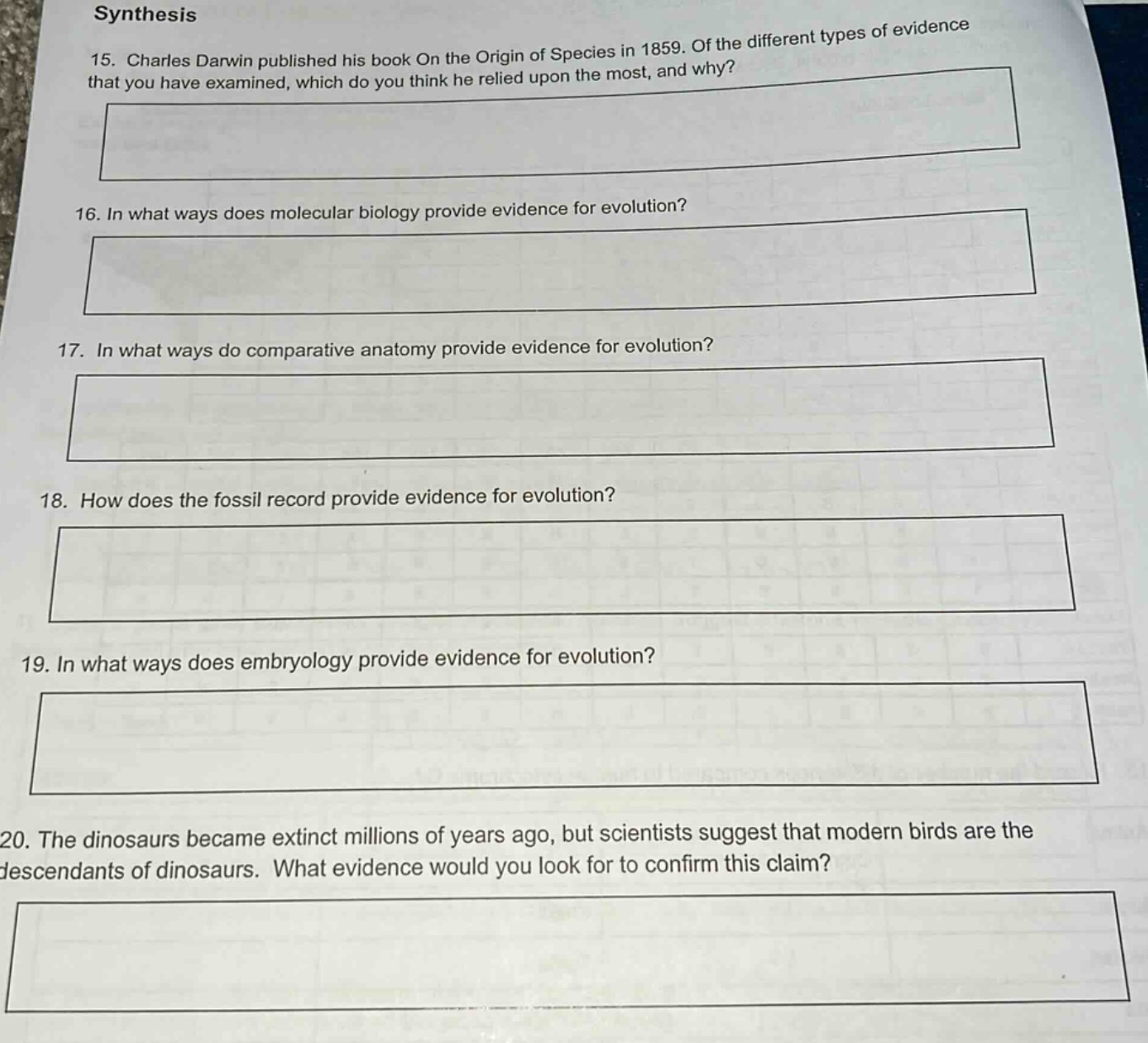
synthesis\n15. charles darwin published his book on the origin of species in 1859. of the different types of evidence that you have examined, which do you think he relied upon the most, and why?\n16. in what ways does molecular biology provide evidence for evolution?\n17. in what ways do comparative anatomy provide evidence for evolution?\n18. how does the fossil record provide evidence for evolution?\n19. in what ways does embryology provide evidence for evolution?\n20. the dinosaurs became extinct millions of years ago, but scientists suggest that modern birds are the descendants of dinosaurs. what evidence would you look for to confirm this claim?
Answer
Brief Explanations:
- Darwin likely relied on the fossil record and comparative anatomy most. The fossil record showed a succession of life - forms over time, providing evidence of change. Comparative anatomy revealed similarities in the body structures of different species, suggesting common ancestry.
- Molecular biology provides evidence through DNA and protein sequence comparisons. Species with more similar sequences are likely more closely related, indicating a shared evolutionary history. Also, the presence of conserved genes across different organisms supports evolution.
- Comparative anatomy shows homologous structures (same structure, different function) like the fore - limbs of mammals, which suggest a common ancestor. Analogous structures (same function, different structure) like wings of birds and insects show convergent evolution. Vestigial structures, such as the human appendix, are remnants of once - useful structures in ancestors.
- The fossil record provides a chronological sequence of life. Fossils of extinct species and transitional forms (like Archaeopteryx) show the gradual change of organisms over time, filling in the gaps in the evolutionary history of different groups.
- Embryology shows that embryos of different species have similar stages of development. For example, all vertebrate embryos have gill slits and a tail at some point, indicating a common evolutionary origin.
- To confirm that modern birds are descendants of dinosaurs, look for fossil evidence of transitional forms with features of both dinosaurs and birds (like feathers on dinosaur fossils). Also, compare DNA sequences between birds and dinosaurs (if possible from well - preserved fossils), and study similarities in skeletal structures such as the wishbone and hollow bones.
Answer:
- He likely relied on the fossil record and comparative anatomy most. The fossil record shows succession of life - forms, and comparative anatomy reveals structural similarities suggesting common ancestry.
- Through DNA and protein sequence comparisons, conserved genes.
- Homologous, analogous and vestigial structures.
- Chronological sequence, presence of extinct and transitional forms.
- Similar embryonic development stages among vertebrates.
- Fossil evidence of transitional forms, DNA sequence comparison, skeletal structure similarities.