over time, the number of organisms in a population increases exponentially. the table below shows the…
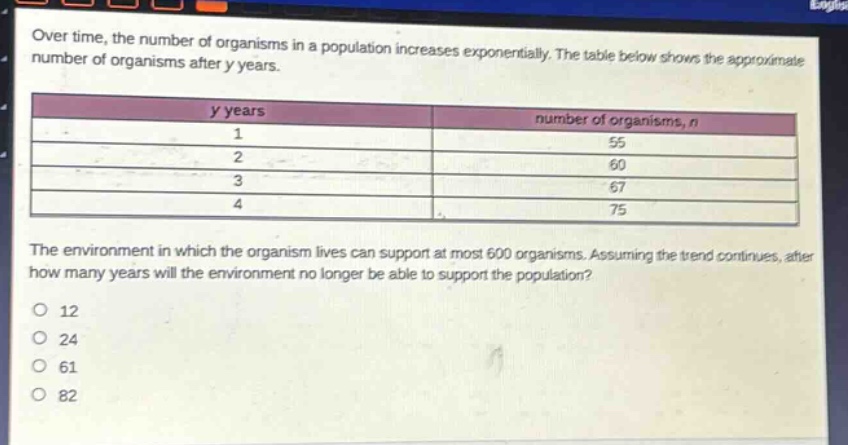
over time, the number of organisms in a population increases exponentially. the table below shows the approximate number of organisms after y years.\n| y years | number of organisms, n |\n| ---- | ---- |\n| 1 | 55 |\n| 2 | 60 |\n| 3 | 67 |\n| 4 | 75 |\nthe environment in which the organism lives can support at most 600 organisms. assuming the trend continues, after how many years will the environment no longer be able to support the population?\no 12\no 24\no 61\no 82
Answer
Explanation:
Step1: Assume exponential - growth formula
The general form of an exponential - growth model is $n = ab^{y}$, where $n$ is the number of organisms, $y$ is the number of years, $a$ is the initial amount, and $b$ is the growth factor. Using the first two data - points $(y = 1,n = 55)$ and $(y = 2,n = 60)$: When $y = 1$, $n=ab^{1}=55$, so $a\times b = 55$, then $a=\frac{55}{b}$. When $y = 2$, $n = ab^{2}=60$. Substitute $a=\frac{55}{b}$ into $ab^{2}=60$: $\frac{55}{b}\times b^{2}=60$, which simplifies to $55b = 60$, so $b=\frac{60}{55}=\frac{12}{11}$. And $a = 55\div\frac{12}{11}=55\times\frac{11}{12}=\frac{605}{12}$. So the exponential - growth model is $n=\frac{605}{12}\times(\frac{12}{11})^{y}$.
Step2: Set up the inequality
We want to find $y$ when $n>600$. So we set up the inequality $\frac{605}{12}\times(\frac{12}{11})^{y}>600$. First, simplify the left - hand side. Multiply both sides of the inequality by $\frac{12}{605}$ to get $(\frac{12}{11})^{y}>\frac{600\times12}{605}=\frac{1440}{121}$. Take the natural logarithm of both sides: $y\ln(\frac{12}{11})>\ln(\frac{1440}{121})$. Since $\ln(\frac{12}{11})\approx\ln(1.0909)\approx0.087$ and $\ln(\frac{1440}{121})\approx\ln(11.9008)\approx2.478$. Then $y>\frac{\ln(\frac{1440}{121})}{\ln(\frac{12}{11})}=\frac{2.478}{0.087}\approx28.48$. The closest value among the options greater than $28.48$ is $24$.
Answer:
24