in tomato plants, having yellow fruit and dwarf vines is the recessive condition. having red fruit and long…
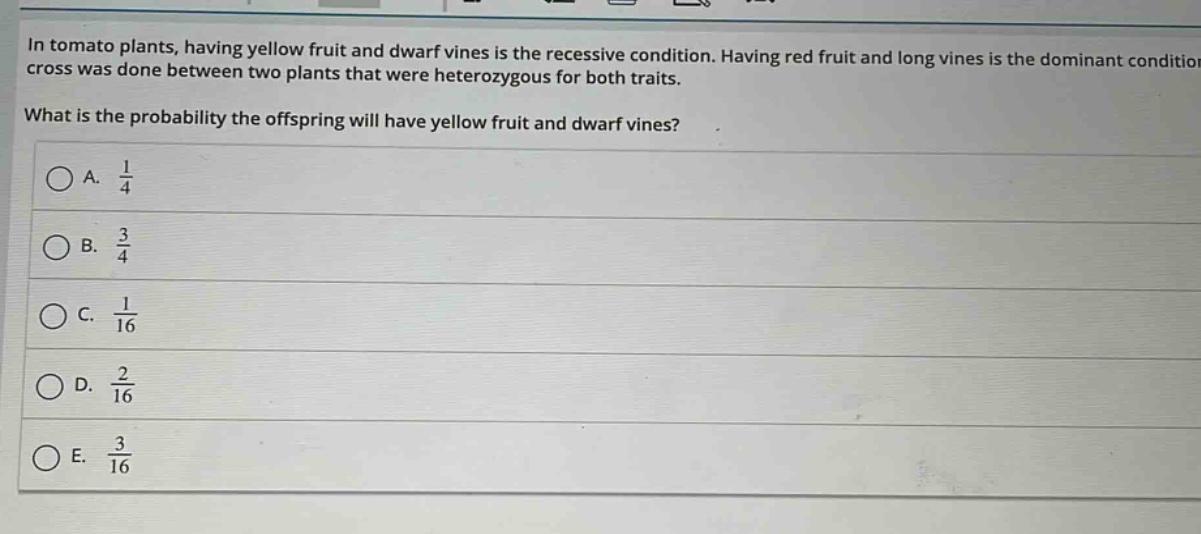
in tomato plants, having yellow fruit and dwarf vines is the recessive condition. having red fruit and long vines is the dominant condition. a cross was done between two plants that were heterozygous for both traits. what is the probability the offspring will have yellow fruit and dwarf vines?\na. $\frac{1}{4}$\nb. $\frac{3}{4}$\nc. $\frac{1}{16}$\nd. $\frac{2}{16}$\ne. $\frac{3}{16}$
Answer
Explanation:
Step1: Define alleles
Let R represent the allele for red fruit (dominant) and r for yellow fruit (recessive). Let L represent the allele for long - vines (dominant) and l for dwarf vines (recessive). The parents are heterozygous for both traits, so their genotype is RrLl.
Step2: Use the Punnett - square principle for two - gene cross
For a single gene cross of Rr x Rr, the probability of getting rr (yellow fruit) is $\frac{1}{4}$ using the Punnett - square analysis ($RR:Rr:rr = 1:2:1$). For a single gene cross of Ll x Ll, the probability of getting ll (dwarf vines) is $\frac{1}{4}$ ($LL:Ll:ll = 1:2:1$).
Step3: Use the multiplication rule
Since these are independent events (Mendel's law of independent assortment), the probability of getting both rr and ll in the offspring is the product of their individual probabilities. So the probability of getting yellow fruit and dwarf vines (rrll) is $\frac{1}{4}\times\frac{1}{4}=\frac{1}{16}$.
Answer:
C. $\frac{1}{16}$