two cells in the same organism differ only in the number of chloroplasts they contain. the first cell has…
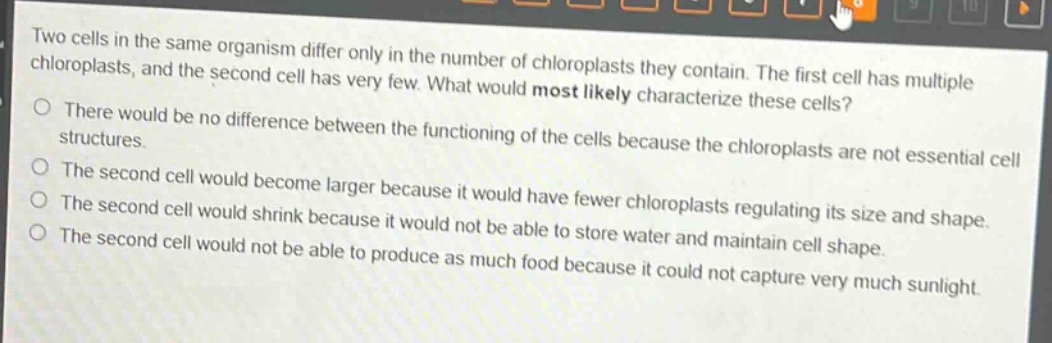
two cells in the same organism differ only in the number of chloroplasts they contain. the first cell has multiple chloroplasts, and the second cell has very few. what would most likely characterize these cells?\nthere would be no difference between the functioning of the cells because the chloroplasts are not essential cell structures.\nthe second cell would become larger because it would have fewer chloroplasts regulating its size and shape.\nthe second cell would shrink because it would not be able to store water and maintain cell shape.\nthe second cell would not be able to produce as much food because it could not capture very much sunlight.
Answer
Answer:
The second cell would not be able to produce as much food because it could not capture very much sunlight.
Explanation:
Step1: Understand chloroplast function
Chloroplasts are sites of photosynthesis.
Step2: Analyze impact of chloroplast number
Fewer chloroplasts mean less sunlight - capture for photosynthesis.
Step3: Determine cell - function difference
Less photosynthesis results in less food production.