type the correct answer in each box. use numerals instead of words. if necessary, use / for the fraction…
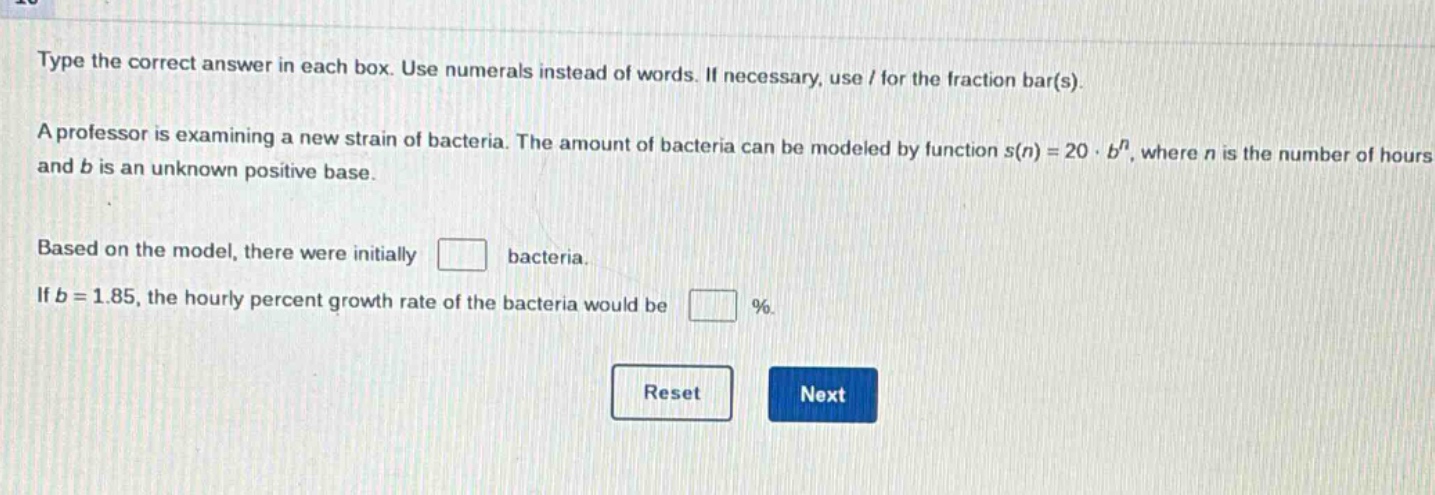
type the correct answer in each box. use numerals instead of words. if necessary, use / for the fraction bar(s). a professor is examining a new strain of bacteria. the amount of bacteria can be modeled by function s(n)=20·b^n, where n is the number of hours and b is an unknown positive base. based on the model, there were initially bacteria. if b = 1.85, the hourly percent growth rate of the bacteria would be %.
Answer
Answer:
20 85
Explanation:
Step1: Find initial amount
When $n = 0$, $s(0)=20\cdot b^{0}$. Since any non - zero number to the power of 0 is 1 ($b^{0}=1$), then $s(0)=20\times1 = 20$.
Step2: Calculate growth rate
The general form of an exponential growth function is $y = a(1 + r)^{t}$, where $r$ is the growth rate. Given $s(n)=20\cdot b^{n}$ and $b = 1.85$, we can write it as $s(n)=20\cdot(1 + r)^{n}$. So $1 + r=1.85$, then $r=1.85 - 1=0.85$. To convert to a percentage, we multiply by 100, so $r = 85%$.