unattached earlobes are dominant to attached earlobes. cleft chin is dominant to no cleft. parents that are…
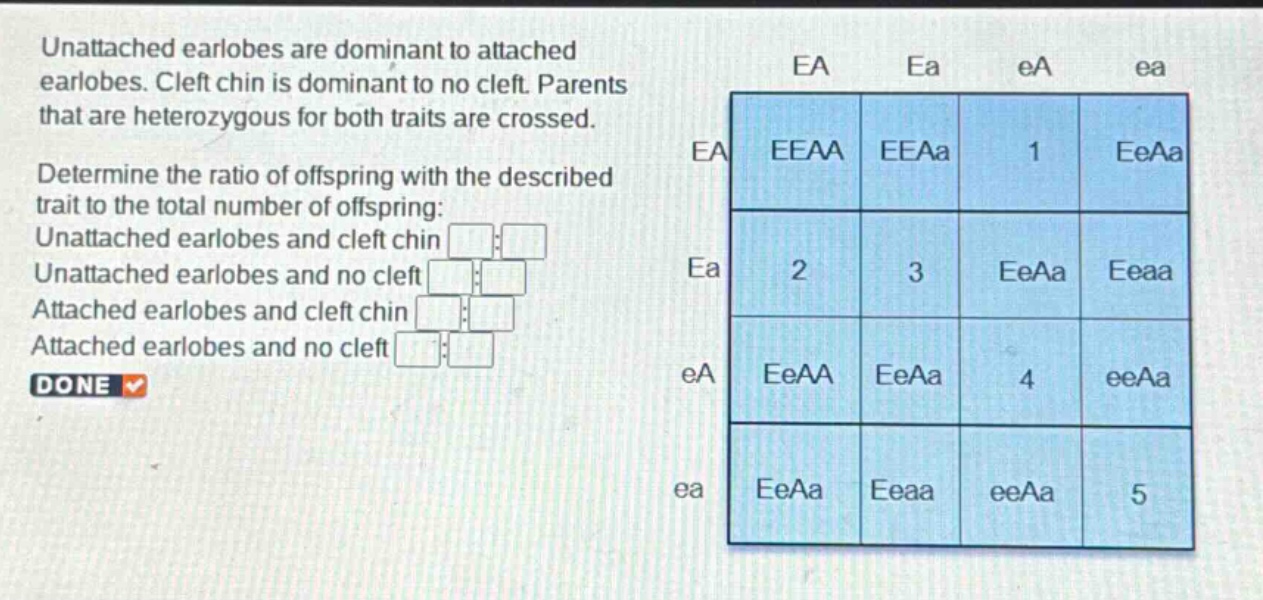
unattached earlobes are dominant to attached earlobes. cleft chin is dominant to no cleft. parents that are heterozygous for both traits are crossed. determine the ratio of offspring with the described trait to the total number of offspring: unattached earlobes and cleft chin unattached earlobes and no cleft attached earlobes and cleft chin attached earlobes and no cleft done
Answer
Explanation:
Step1: Determine the genotypes for dominant - recessive traits
Let (E) represent the allele for unattached earlobes (dominant) and (e) for attached earlobes (recessive). Let (A) represent the allele for cleft chin (dominant) and (a) for no - cleft chin (recessive). The parents are heterozygous for both traits, so their genotype is (EeAa).
Step2: Use a Punnett - square analysis
The possible gametes from each parent are (EA), (Ea), (eA), and (ea). When we set up a (4\times4) Punnett - square, there are a total of (4\times4 = 16) possible genotypes for the offspring.
Step3: Determine the genotypes for each phenotype
- Unattached earlobes and cleft chin: Genotypes with at least one (E) and one (A) are (EEAA), (EEAa), (EeAA), (EeAa). Counting these genotypes in the Punnett - square, we have 9 out of 16.
- Unattached earlobes and no cleft: Genotypes with at least one (E) and two (a)'s are (EEaa), (Eeaa). There are 3 out of 16.
- Attached earlobes and cleft chin: Genotypes with two (e)'s and at least one (A) are (eeAA), (eeAa). There are 3 out of 16.
- Attached earlobes and no cleft: Genotype is (eeaa), which is 1 out of 16.
Answer:
Unattached earlobes and cleft chin: (9:16) Unattached earlobes and no cleft: (3:16) Attached earlobes and cleft chin: (3:16) Attached earlobes and no cleft: (1:16)