understanding main ideas\n1. what structural features of pea plant flowers made them suitable for mendels…
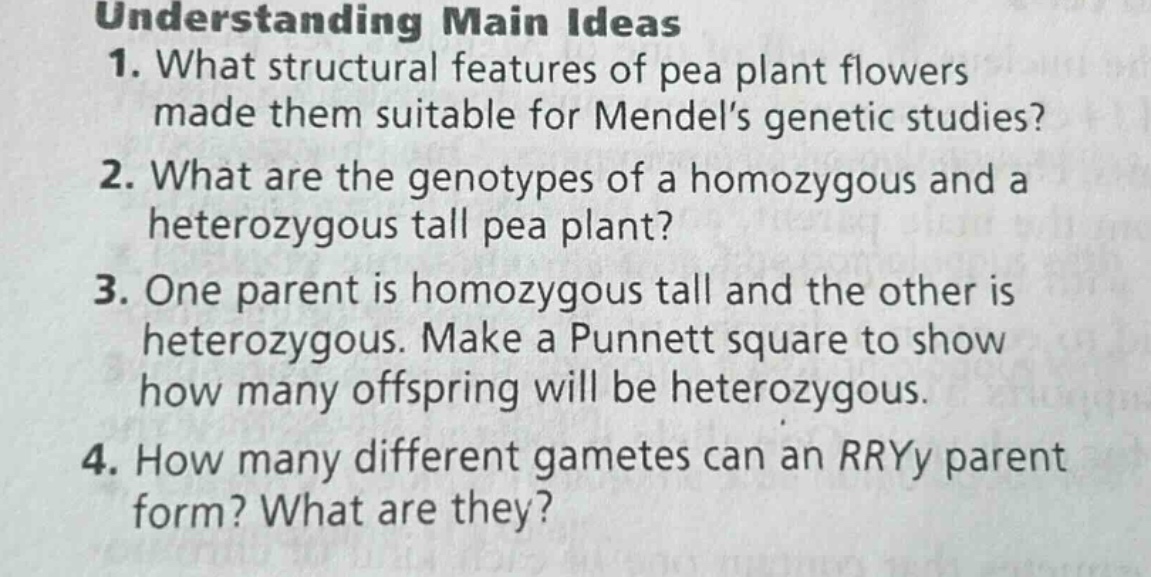
understanding main ideas\n1. what structural features of pea plant flowers made them suitable for mendels genetic studies?\n2. what are the genotypes of a homozygous and a heterozygous tall pea plant?\n3. one parent is homozygous tall and the other is heterozygous. make a punnett square to show how many offspring will be heterozygous.\n4. how many different gametes can an rryy parent form? what are they?
Answer
Explanation:
Step1: Answer to question 1
Pea - plant flowers have several features. They are self - pollinating and can be cross - pollinated easily. They have distinct and easily observable traits such as flower color, plant height etc. These made them suitable for Mendel's genetic studies.
Step2: Answer to question 2
The genotype of a homozygous tall pea plant is TT. The genotype of a heterozygous tall pea plant is Tt.
Step3: Answer to question 3
Let the homozygous tall parent have genotype TT and the heterozygous tall parent have genotype Tt. The Punnett square:
| T | T | |
|---|---|---|
| T | TT | TT |
| t | Tt | Tt |
| Half (50%) of the offspring will be heterozygous (Tt). |
Step4: Answer to question 4
For an RRYy parent, the R gene is homozygous (RR) and the Y gene is heterozygous (Yy). Using the principle of independent assortment, the possible gametes are RY and Ry. So, 2 different gametes can be formed.
Answer:
- They are self - pollinating, can be cross - pollinated easily and have distinct observable traits.
- Homozygous tall: TT; Heterozygous tall: Tt
- 50% of the offspring will be heterozygous.
- 2 different gametes; RY and Ry