while investigating a break - in, the police discover that the intruder was cut on the broken window that he…
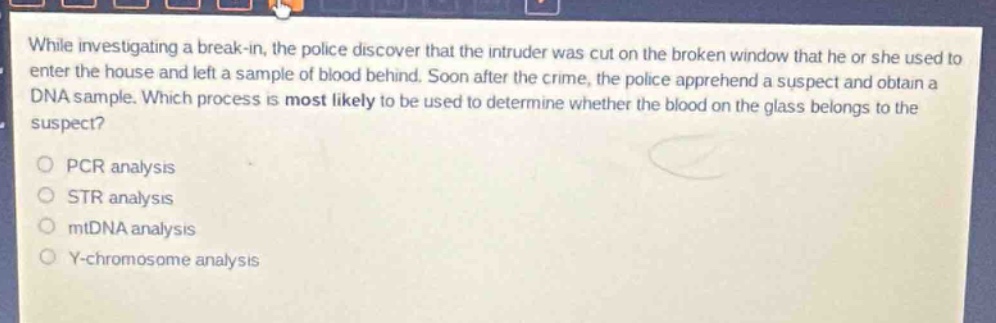
while investigating a break - in, the police discover that the intruder was cut on the broken window that he or she used to enter the house and left a sample of blood behind. soon after the crime, the police apprehend a suspect and obtain a dna sample. which process is most likely to be used to determine whether the blood on the glass belongs to the suspect?\npcr analysis\nstr analysis\nmtdna analysis\ny - chromosome analysis
Answer
Brief Explanations:
STR (Short - Tandem Repeat) analysis is commonly used in forensic DNA profiling to match DNA samples. It analyzes specific regions of DNA with repeating sequences. PCR (Polymerase Chain Reaction) is a technique used to amplify DNA, not the main process for matching samples. mtDNA (mitochondrial DNA) analysis is useful for maternal - lineage studies and in some cases where nuclear DNA is degraded. Y - chromosome analysis is used for male - specific lineage studies. For matching a suspect's DNA to a crime - scene sample, STR analysis is the most likely.
Answer:
STR analysis