white feathers in canaries are dominant to yellow feathers. a heterozygous canary is crossed with a…
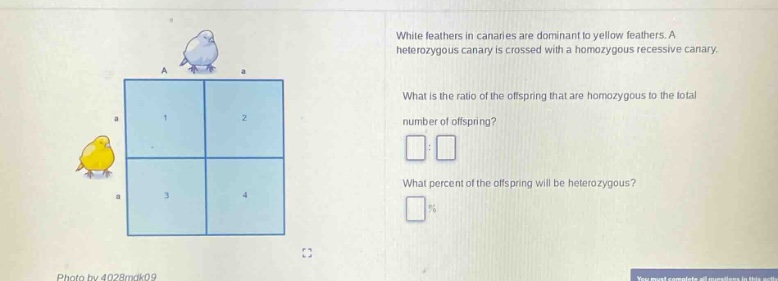
white feathers in canaries are dominant to yellow feathers. a heterozygous canary is crossed with a homozygous recessive canary. what is the ratio of the offspring that are homozygous to the total number of offspring? what percent of the offspring will be heterozygous?
Answer
Explanation:
Step1: Set up the cross
Let the allele for white feathers be (A) (dominant) and for yellow feathers be (a) (recessive). A heterozygous canary has genotype (Aa) and a homozygous - recessive canary has genotype (aa). The Punnett - square cross is (Aa\times aa).
Step2: Fill in the Punnett - square
The possible gametes from (Aa) are (A) and (a), and from (aa) are (a) and (a). Filling the Punnett - square:
| a | a | |
|---|---|---|
| A | Aa | Aa |
| a | aa | aa |
Step3: Determine genotypes of offspring
The genotypes of the offspring are (Aa:Aa:aa:aa).
Step4: Calculate ratio of homozygous offspring
The homozygous offspring have genotype (aa). There are 2 homozygous ((aa)) offspring out of 4 total offspring. The ratio of homozygous offspring to total offspring is (2:4 = 1:2).
Step5: Calculate percentage of heterozygous offspring
The heterozygous offspring have genotype (Aa). There are 2 heterozygous ((Aa)) offspring out of 4 total offspring. The percentage of heterozygous offspring is (\frac{2}{4}\times100%=50%).
Answer:
1:2 50%