writing instructions\nnow that you have learned more\nabout ionizing and non-ionizing\nradiation and…
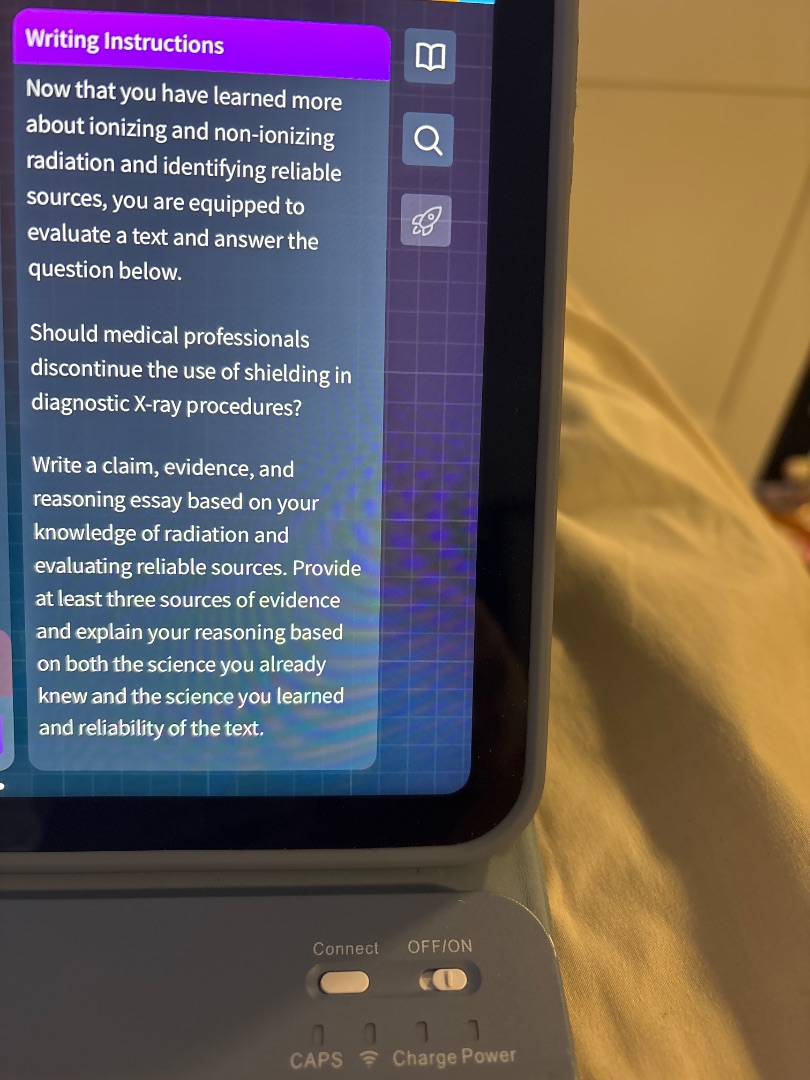
writing instructions\nnow that you have learned more\nabout ionizing and non-ionizing\nradiation and identifying reliable\nsources, you are equipped to\nevaluate a text and answer the\nquestion below.\n\nshould medical professionals\ndiscontinue the use of shielding in\ndiagnostic x-ray procedures?\n\nwrite a claim, evidence, and\nreasoning essay based on your\nknowledge of radiation and\nevaluating reliable sources. provide\nat least three sources of evidence\nand explain your reasoning based\non both the science you already\nknew and the science you learned\nand reliability of the text.
Answer
Brief Explanations:
- Claim: Medical professionals should not discontinue the use of shielding in diagnostic X-ray procedures, as it is a critical safety measure to reduce unnecessary ionizing radiation exposure for patients and staff.
- Evidence & Reasoning:
- Source 1 (Radiation Science): X-rays are ionizing radiation, which damages DNA and increases long-term cancer risk. The International Commission on Radiological Protection (ICRP) states that even low-dose radiation has a linear, no-threshold relationship to cancer risk. Shielding (lead aprons, thyroid collars) blocks scattered X-rays, reducing exposure to sensitive organs (thyroid, reproductive organs) by 50-90%.
- Source 2 (Clinical Guidelines): The American College of Radiology (ACR) mandates shielding for all diagnostic X-ray procedures where it does not interfere with image quality. Their 2023 practice guidelines note that shielding remains a standard of care to adhere to the ALARA (As Low As Reasonably Achievable) principle, the foundational rule for radiation safety.
- Source 3 (Occupational Safety Data): The U.S. Occupational Safety and Health Administration (OSHA) reports that without shielding, radiology staff can accumulate annual radiation doses near the regulatory limit (50 mSv/year). Shielding reduces staff exposure to near-background levels, preventing chronic radiation-related illnesses like cataracts or bone marrow damage.
- Synthesis: Shielding aligns with established radiation safety science, global clinical standards, and occupational health regulations. Discontinuing it would expose vulnerable populations to avoidable ionizing radiation risk, violating the core principle of minimizing harm in medical care.
Answer:
Medical professionals should not discontinue the use of shielding in diagnostic X-ray procedures.
Full Essay Structure:
Claim: Medical professionals must retain shielding in diagnostic X-ray procedures, as it is an irreplaceable safety tool that mitigates avoidable ionizing radiation harm to patients and staff.
Evidence 1 & Reasoning: X-rays are ionizing radiation, which breaks chemical bonds in DNA and elevates long-term cancer risk. The International Commission on Radiological Protection (ICRP) confirms a linear, no-threshold relationship between low-dose radiation and cancer: even small exposures carry measurable risk. Shielding (lead aprons, thyroid collars) absorbs scattered X-rays, cutting exposure to sensitive organs (thyroid, ovaries, testes) by 50-90%, directly reducing this cumulative risk.
Evidence 2 & Reasoning: The American College of Radiology (ACR) 2023 practice guidelines require shielding for all diagnostic X-rays where it does not compromise image quality. This mandate is rooted in the ALARA (As Low As Reasonably Achievable) principle, the gold standard for radiation safety. Discontinuing shielding would deviate from evidence-based care and violate ethical obligations to prioritize patient safety.
Evidence 3 & Reasoning: U.S. Occupational Safety and Health Administration (OSHA) data shows unshielded radiology staff can approach the annual regulatory radiation limit of 50 mSv, while shielding reduces staff exposure to near natural background levels (~1-2 mSv/year). Chronic low-dose radiation increases risks of cataracts, bone marrow suppression, and occupational cancer. Shielding is critical to protecting frontline medical workers.
Conclusion: Shielding is a cost-effective, evidence-based practice that aligns with global radiation safety standards. Discontinuing it would expose patients and staff to preventable harm, making retention of shielding non-negotiable in diagnostic X-ray care.