what should you do differently if performing cpr on an infant instead of an adult? check all that…
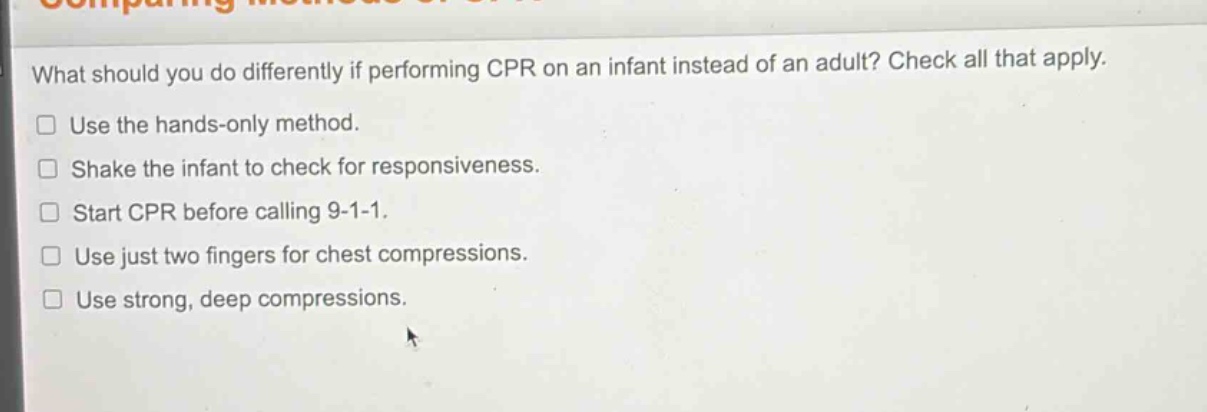
what should you do differently if performing cpr on an infant instead of an adult? check all that apply.\nuse the hands - only method.\nshake the infant to check for responsiveness.\nstart cpr before calling 9 - 1 - 1.\nuse just two fingers for chest compressions.\nuse strong, deep compressions.
Answer
Brief Explanations:
-
Start CPR before calling 9 - 1 - 1: For infants, it is recommended to start CPR immediately (5 cycles of 30 compressions and 2 breaths) before calling emergency services. This is because the cause of cardiac arrest in infants is often respiratory - related, and immediate CPR can help oxygenate the blood.
-
Use just two fingers for chest compressions: Infants have smaller bodies. Using two fingers (usually the index and middle fingers of one hand) for chest compressions is appropriate to avoid over - compression and potential injury. The depth of compressions for an infant is about 1.5 inches.
-
Use the hands - only method: This is incorrect. Hands - only CPR is mainly recommended for adult bystanders who are not trained in traditional CPR (with breaths). Infants need both compressions and breaths as their cardiac arrest is often due to respiratory failure.
-
Shake the infant to check for responsiveness: Shaking an infant can cause serious injury (such as shaken baby syndrome). Instead, tap the infant gently on the foot and shout softly.
-
Use strong, deep compressions: Strong, deep compressions (like those for adults, which are about 2 inches deep) can cause internal injuries in infants. As mentioned, a shallower depth (1.5 inches) with two fingers is appropriate.
Answer:
Start CPR before calling 9 - 1 - 1, Use just two fingers for chest compressions.