you have gone into the field to take water samples from two lakes in your town. you note the following…
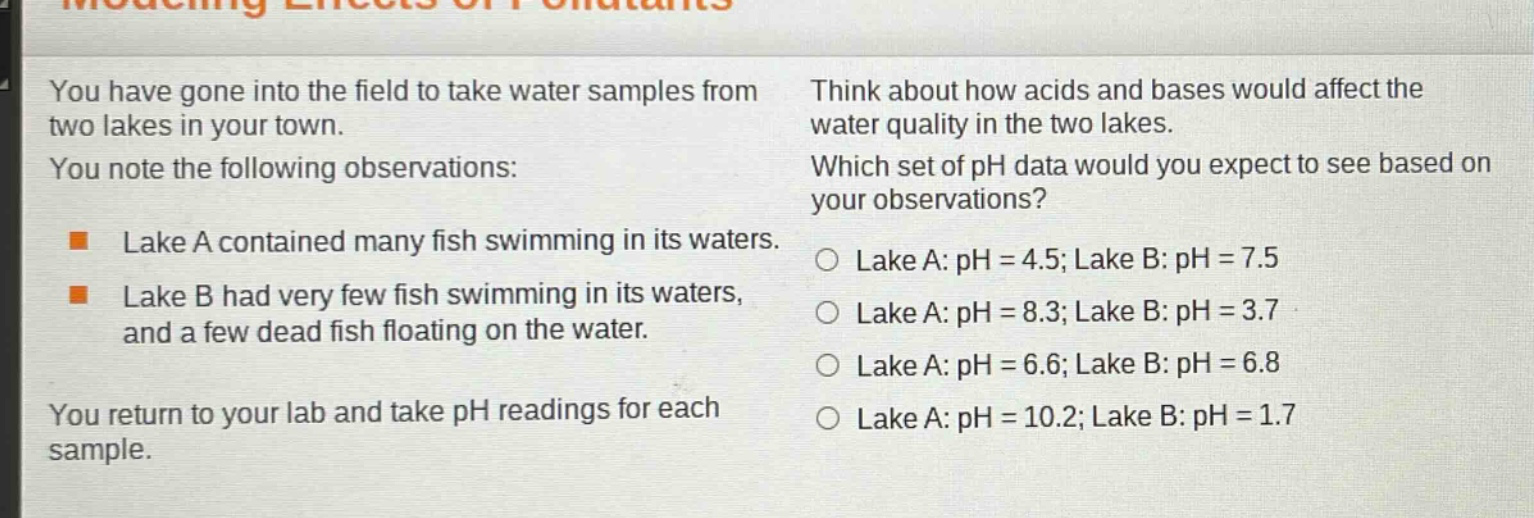
you have gone into the field to take water samples from two lakes in your town. you note the following observations: lake a contained many fish swimming in its waters. lake b had very few fish swimming in its waters, and a few dead fish floating on the water. you return to your lab and take ph readings for each sample. think about how acids and bases would affect the water quality in the two lakes. which set of ph data would you expect to see based on your observations? lake a: ph = 4.5; lake b: ph = 7.5 lake a: ph = 8.3; lake b: ph = 3.7 lake a: ph = 6.6; lake b: ph = 6.8 lake a: ph = 10.2; lake b: ph = 1.7
Answer
Answer:
Lake A: pH = 6.6; Lake B: pH = 6.8
Explanation:
Step1: Recall fish - pH relationship
Fish generally thrive in near - neutral pH waters.
Step2: Analyze options
Options with extreme pH values (very acidic or very basic) are not suitable for fish survival. A pH close to 7 is ideal for fish. Lake A with many fish should have a near - neutral pH, and Lake B with few fish and dead fish may have a less suitable pH. Among the options, a pair of pH values close to 7 like 6.6 and 6.8 is the most likely for the described conditions.