what would you do?\nread the scenarios and decide what you personally would do in those situations. be as…
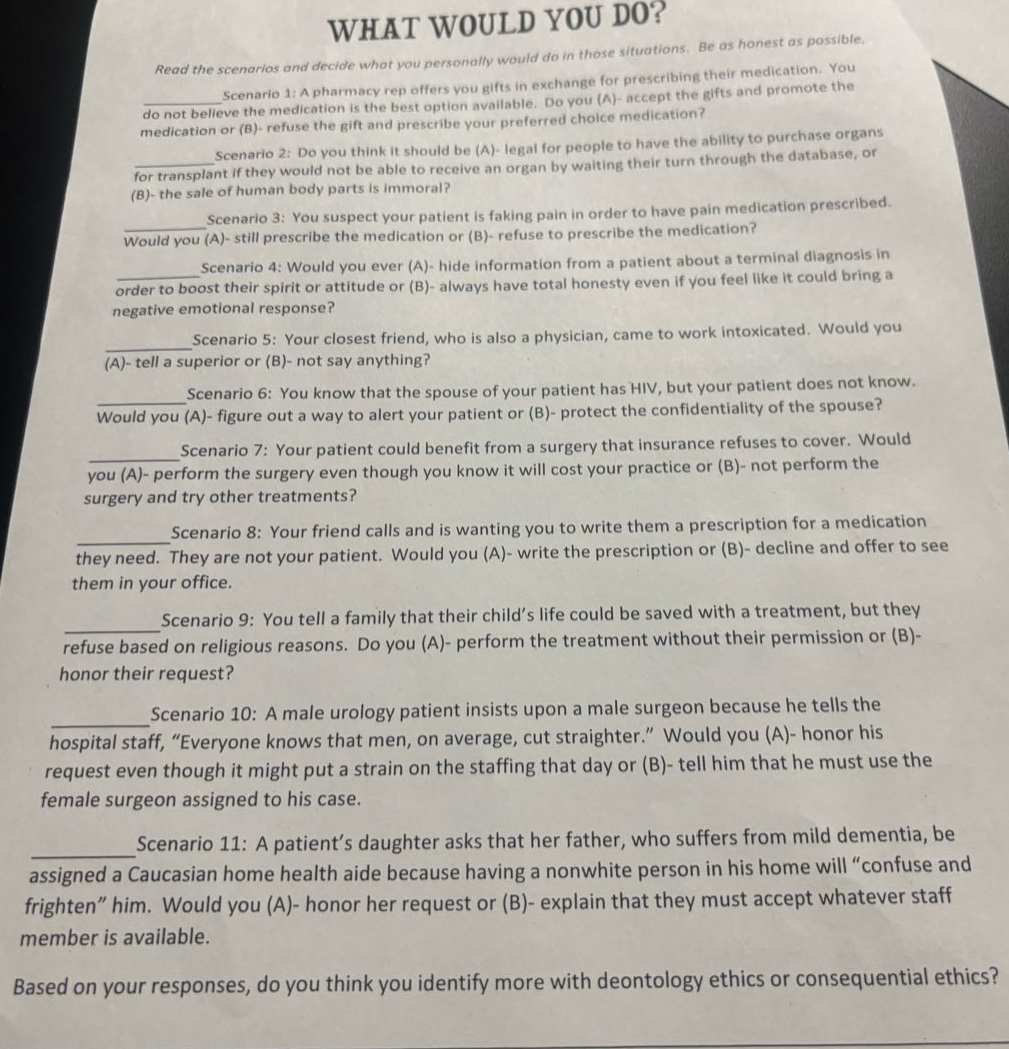
what would you do?\nread the scenarios and decide what you personally would do in those situations. be as honest as possible.\nscenario 1: a pharmacy rep offers you gifts in exchange for prescribing their medication. you do not believe the medication is the best option available. do you (a)- accept the gifts and promote the medication or (b)- refuse the gift and prescribe your preferred choice medication?\nscenario 2: do you think it should be (a)- legal for people to have the ability to purchase organs for transplant if they would not be able to receive an organ by waiting their turn through the database, or (b)- the sale of human body parts is immoral?\nscenario 3: you suspect your patient is faking pain in order to have pain medication prescribed. would you (a)- still prescribe the medication or (b)- refuse to prescribe the medication?\nscenario 4: would you ever (a)- hide information from a patient about a terminal diagnosis in order to boost their spirit or attitude or (b)- always have total honesty even if you feel like it could bring a negative emotional response?\nscenario 5: your closest friend, who is also a physician, came to work intoxicated. would you (a)- tell a superior or (b)- not say anything?\nscenario 6: you know that the spouse of your patient has hiv, but your patient does not know. would you (a)- figure out a way to alert your patient or (b)- protect the confidentiality of the spouse?\nscenario 7: your patient could benefit from a surgery that insurance refuses to cover. would you (a)- perform the surgery even though you know it will cost your practice or (b)- not perform the surgery and try other treatments?\nscenario 8: your friend calls and is wanting you to write them a prescription for a medication they need. they are not your patient. would you (a)- write the prescription or (b)- decline and offer to see them in your office.\nscenario 9: you tell a family that their child’s life could be saved with a treatment, but they refuse based on religious reasons. do you (a)- perform the treatment without their permission or (b)- honor their request?\nscenario 10: a male urology patient insists upon a male surgeon because he tells the hospital staff, “everyone knows that men, on average, cut straighter.” would you (a)- honor his request even though it might put a strain on the staffing that day or (b)- tell him that he must use the female surgeon assigned to his case.\nscenario 11: a patient’s daughter asks that her father, who suffers from mild dementia, be assigned a caucasian home health aide because having a nonwhite person in his home will “confuse and frighten” him. would you (a)- honor her request or (b)- explain that they must accept whatever staff member is available.\nbased on your responses, do you think you identify more with deontology ethics or consequential ethics?
Answer
Brief Explanations:
This set of scenarios presents ethical - decision - making situations in a medical context. Deontology focuses on following moral rules and duties regardless of the consequences, while consequential ethics evaluates actions based on their outcomes. For example, in Scenario 1, refusing the gift (B) based on ethical rules of non - corruption aligns with deontology. In Scenario 4, always being honest (B) even if it may cause negative emotions is a deontological approach as truth - telling is seen as a moral duty. Overall, responses that prioritize moral rules and duties over potential good outcomes tend to be deontological, and responses that consider the best overall outcome for patients or others are consequentialist.
Answer:
Responses vary based on individual moral perspectives. If one consistently chooses options based on moral rules and duties (e.g., refusing gifts, always being honest), they may identify more with deontology. If one chooses options based on what will lead to the best overall outcome (e.g., performing surgery to benefit the patient despite cost), they may identify more with consequential ethics.