18 mark for review f(t)=9,000(0.67)^t the given function f models the number of catalogs a company sent to…
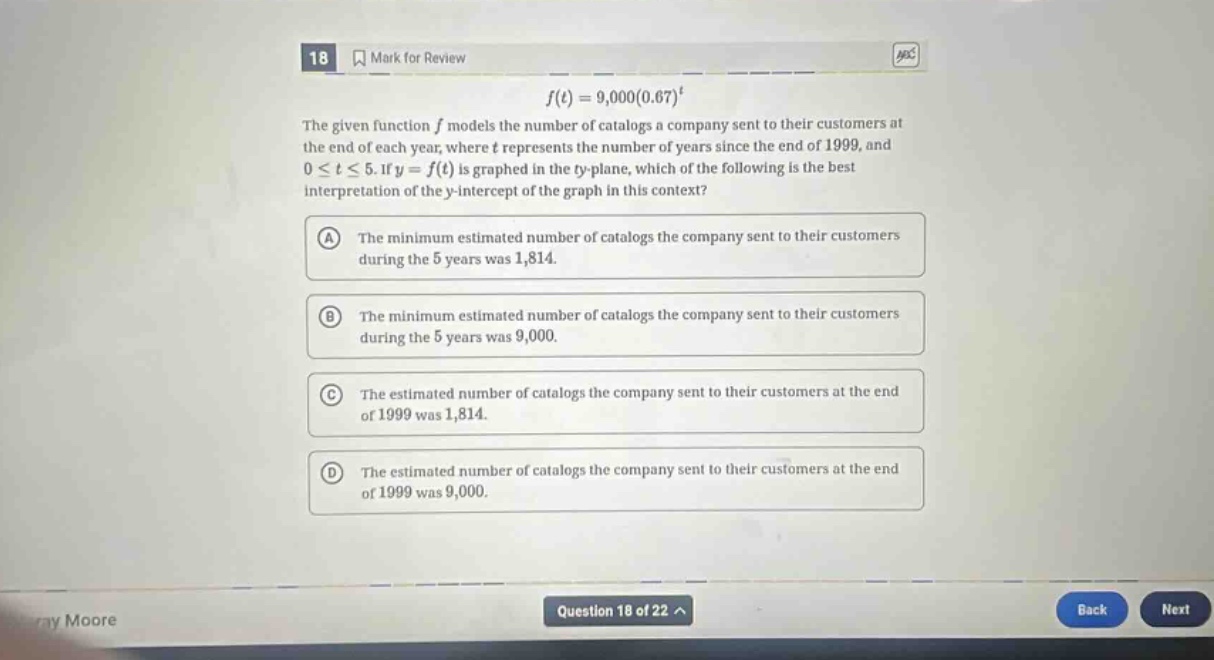
18 mark for review f(t)=9,000(0.67)^t the given function f models the number of catalogs a company sent to their customers at the end of each year, where t represents the number of years since the end of 1999, and 0 < t ≤ 5. if y = f(t) is graphed in the ty - plane, which of the following is the best interpretation of the y - intercept of the graph in this context? a the minimum estimated number of catalogs the company sent to their customers during the 5 years was 1,814. b the minimum estimated number of catalogs the company sent to their customers during the 5 years was 9,000. c the estimated number of catalogs the company sent to their customers at the end of 1999 was 1,814. d the estimated number of catalogs the company sent to their customers at the end of 1999 was 9,000. question 18 of 22
Answer
Explanation:
Step1: Recall y - intercept concept
The y - intercept of a function $y = f(t)$ is found when $t = 0$.
Step2: Substitute $t = 0$ into the function
Given $f(t)=9000(0.67)^t$, when $t = 0$, we have $f(0)=9000(0.67)^0$. Since any non - zero number to the power of 0 is 1, $(0.67)^0 = 1$, so $f(0)=9000\times1=9000$. In the context of the problem, $t$ represents the number of years since the end of 1999. When $t = 0$, it is the end of 1999.
Answer:
D. The estimated number of catalogs the company sent to their customers at the end of 1999 was 9,000.