a bank with branches located in a commercial district of a city and in a residential area has the business…
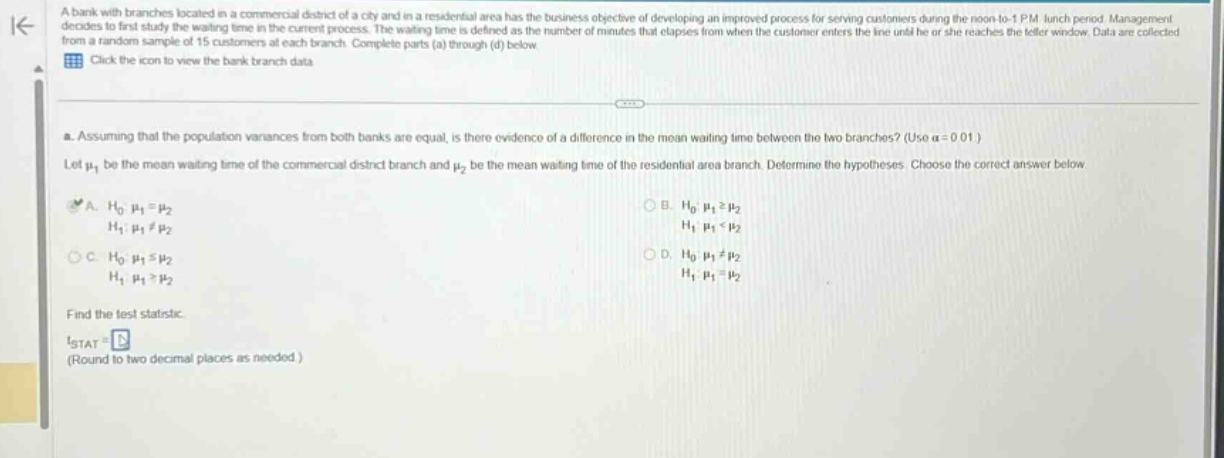
a bank with branches located in a commercial district of a city and in a residential area has the business objective of developing an improved process for serving customers during the noon - to - 1 pm lunch period. management decides to first study the waiting time in the current process. the waiting time is defined as the number of minutes that elapses from when the customer enters the line until he or she reaches the teller window. data are collected from a random sample of 15 customers at each branch. complete parts (a) through (d) below. click the icon to view the bank branch data. a. assuming that the population variances from both banks are equal, is there evidence of a difference in the mean waiting time between the two branches? (use α = 0.01 ) let μ1 be the mean waiting time of the commercial district branch and μ2 be the mean waiting time of the residential area branch. determine the hypotheses. choose the correct answer below. a. h0: μ1 = μ2 h1: μ1 ≠ μ2 b. h0: μ1 ≠ μ2 h1: μ1 < μ2 c. h0: μ1 ≤ μ2 h1: μ1 > μ2 d. h0: μ1 ≠ μ2 h1: μ1 = μ2 find the test statistic. tstat = (round to two decimal places as needed.)
Answer
Explanation:
Step1: Identify hypotheses
The null hypothesis $H_0$ is that there is no difference in means, i.e., $\mu_1=\mu_2$, and the alternative hypothesis $H_1$ is that there is a difference, i.e., $\mu_1\neq\mu_2$. So the correct choice is A. $H_0:\mu_1 = \mu_2$, $H_1:\mu_1\neq\mu_2$.
Step2: Recall two - sample t - test formula
The formula for the two - sample t - statistic when population variances are equal is $t_{STAT}=\frac{(\bar{X}_1-\bar{X}_2)-(\mu_1 - \mu_2)}{S_p\sqrt{\frac{1}{n_1}+\frac{1}{n_2}}}$, where $S_p=\sqrt{\frac{(n_1 - 1)S_1^2+(n_2 - 1)S_2^2}{n_1 + n_2-2}}$, $\bar{X}_1,\bar{X}2$ are sample means, $S_1^2,S_2^2$ are sample variances, and $n_1 = n_2=15$ (given sample size from each branch). However, since the data for sample means, variances are not provided in the question text, we cannot calculate the exact value of $t{STAT}$.
Answer:
A. $H_0:\mu_1 = \mu_2$, $H_1:\mu_1\neq\mu_2$; Cannot calculate $t_{STAT}$ due to lack of data.