the brand manager for a brand of toothpaste must plan a campaign designed to increase brand recognition. he…
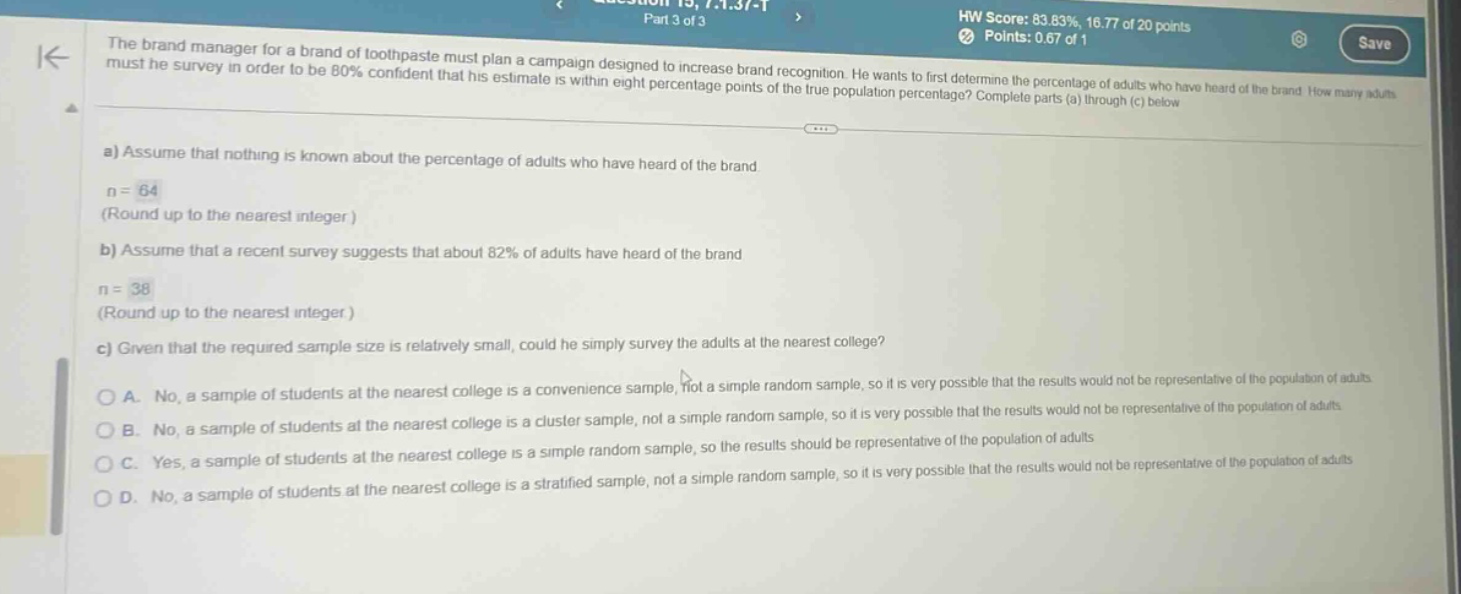
the brand manager for a brand of toothpaste must plan a campaign designed to increase brand recognition. he wants to first determine the percentage of adults who have heard of the brand. how many adults must he survey in order to be 80% confident that his estimate is within eight percentage points of the true population percentage? complete parts (a) through (c) below\n\na) assume that nothing is known about the percentage of adults who have heard of the brand\n\nn = 64\n(round up to the nearest integer)\n\nb) assume that a recent survey suggests that about 82% of adults have heard of the brand\n\nn = 38\n(round up to the nearest integer)\n\nc) given that the required sample size is relatively small, could he simply survey the adults at the nearest college?\n\na. no, a sample of students at the nearest college is a convenience sample, not a simple random sample, so it is very possible that the results would not be representative of the population of adults\n\nb. no, a sample of students at the nearest college is a cluster sample, not a simple random sample, so it is very possible that the results would not be representative of the population of adults\n\nc. yes, a sample of students at the nearest college is a simple random sample, so the results should be representative of the population of adults\n\nd. no, a sample of students at the nearest college is a stratified sample, not a simple random sample, so it is very possible that the results would not be representative of the population of adults
Answer
Explanation:
Step1: Recall sampling concepts
A convenience sample is one where the sample is easily accessible. College - students are an easily accessible group for the brand - manager. A simple random sample requires that every member of the population has an equal chance of being selected. College students do not represent all adults.
Step2: Analyze each option
Option A is correct because a sample of students at the nearest college is a convenience sample, not a simple random sample, and may not be representative of the adult population. Option B is incorrect as it misidentifies the sample as a cluster sample. Option C is incorrect because it wrongly claims it is a simple random sample. Option D is incorrect as it misidentifies the sample as a stratified sample.
Answer:
A. No, a sample of students at the nearest college is a convenience sample, not a simple random sample, so it is very possible that the results would not be representative of the population of adults