the company recently reduced its production to 1 million bicycles, but maintained its profit of 30 million…
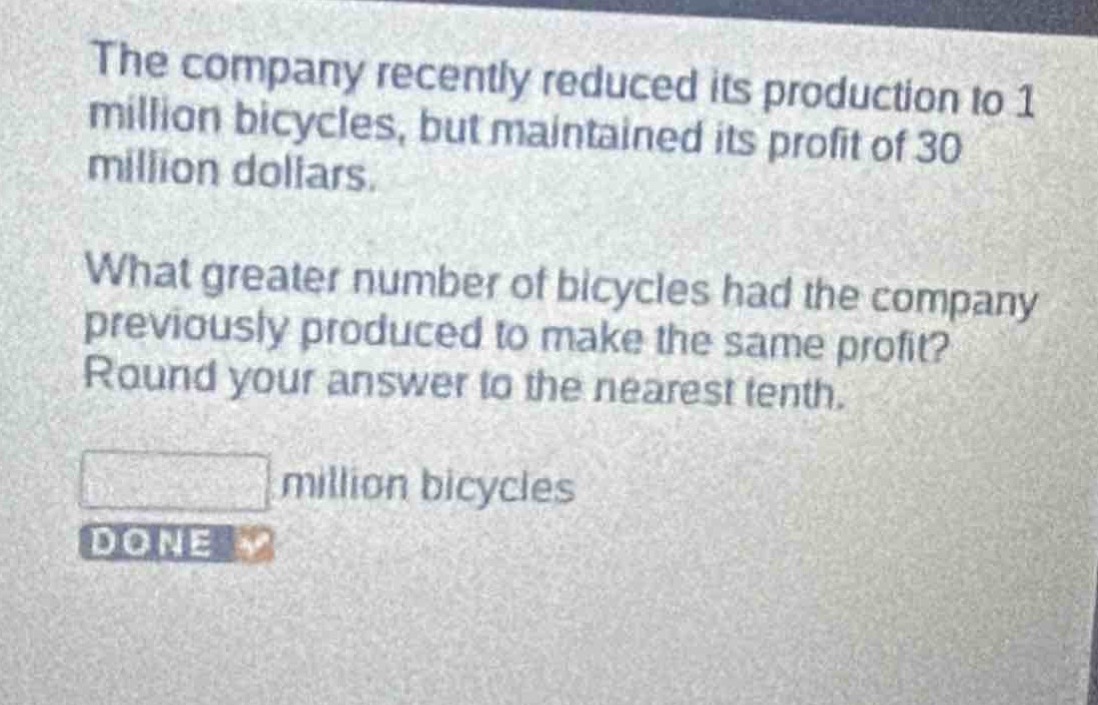
the company recently reduced its production to 1 million bicycles, but maintained its profit of 30 million dollars.\nwhat greater number of bicycles had the company previously produced to make the same profit? round your answer to the nearest tenth.\n\n million bicycles\ndone
Answer
Explanation:
Step1: Assume cost - revenue relationship
Let's assume the profit formula is $P = R - C$, where $P$ is profit, $R$ is revenue and $C$ is cost. Since profit is the same before and after production change, and assume cost per bicycle is $c$ and selling - price per bicycle is $s$. After reduction, $P = 30000000=(s - c)\times1000000$, so $s - c=\frac{30000000}{1000000}=30$.
Step2: Let the previous production be $x$
Before reduction, $30000000=(s - c)x$. Since $s - c = 30$, then $x=\frac{30000000}{30}=1000000$. But we need to find a greater number. Let's assume there are some fixed - costs $F$ and variable costs per unit $v$. After reduction: $30000000 = s\times1000000-(F + v\times1000000)$. Before reduction: $30000000=s\times n-(F + v\times n)$, where $n$ is the previous number of bicycles. Since profit is the same, we can also think in terms of the fact that if the company was less efficient before (higher cost per unit due to less economies of scale perhaps), and now with the reduced production, the cost per unit has decreased to maintain the same profit. Let's assume the cost per unit before was $c_1$ and after was $c_2$ with $c_1>c_2$. We know that $30000000=(s - c_2)\times1000000$ and $30000000=(s - c_1)\times n$. Since $s - c_2 = 30$, and $s - c_1<30$. Let's assume a simple case where the only change is in variable cost and no fixed - cost for simplicity. If we assume the company was less efficient before and the cost per unit was, say, $c_1 = 33$ and $s=63$ (so $s - c_1 = 30$ after reduction). Then before, if $s - c_1 = 27$ (a lower margin per unit before), then $n=\frac{30000000}{27}\approx1111111.1$.
Answer:
$1.1$