7. what is the definition of marketing?\n8. why is exchange the desired outcome of marketing?\n9. what is…
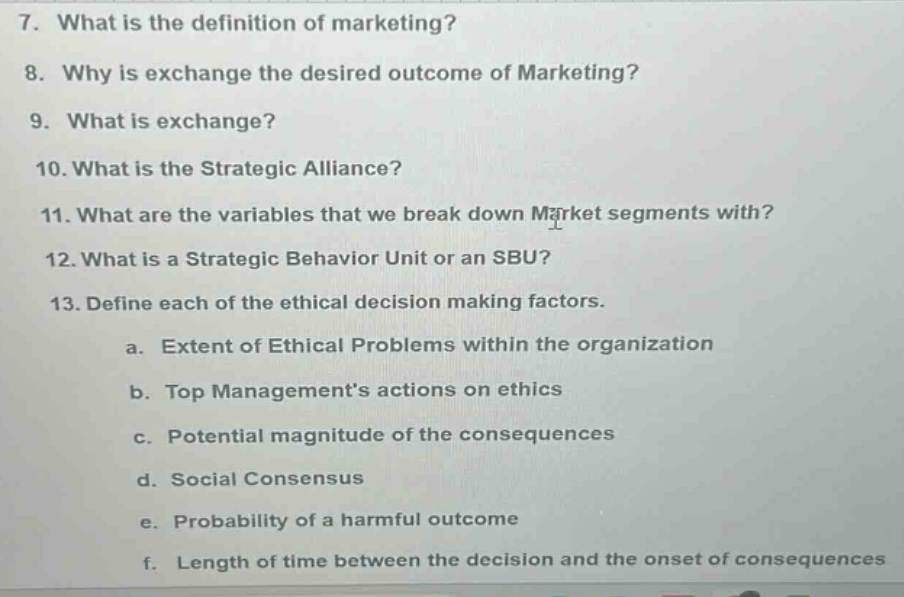
7. what is the definition of marketing?\n8. why is exchange the desired outcome of marketing?\n9. what is exchange?\n10. what is the strategic alliance?\n11. what are the variables that we break down market segments with?\n12. what is a strategic behavior unit or an sbu?\n13. define each of the ethical decision making factors.\n a. extent of ethical problems within the organization\n b. top management’s actions on ethics\n c. potential magnitude of the consequences\n d. social consensus\n e. probability of a harmful outcome\n f. length of time between the decision and the onset of consequences
Answer
Answer:
- Marketing is the process of creating, communicating, delivering, and exchanging offerings that have value for customers, clients, partners, and society at large.
- Exchange is the desired outcome of marketing because it represents the transfer of goods, services, or ideas between a buyer and a seller in which each party perceives value in the transaction. Marketing activities are designed to facilitate and encourage such mutually - beneficial exchanges.
- Exchange is the act of obtaining a desired product from someone by offering something in return. It involves at least two parties, each having something of value to the other, a desire and ability to trade, and a means of communication and delivery.
- A Strategic Alliance is a partnership between two or more organizations to pursue a set of agreed - upon goals while remaining independent organizations. It allows companies to combine resources, expertise, and capabilities to achieve competitive advantages.
- Market segments can be broken down using variables such as demographic (age, gender, income, etc.), geographic (location, climate, etc.), psychographic (lifestyle, values, attitudes, etc.), and behavioral (usage rate, brand loyalty, purchase occasion, etc.).
- A Strategic Behavior Unit (SBU) is a semi - autonomous unit within a larger organization that has its own mission, set of competitors, and strategic plan. It is responsible for its own profitability and has the authority to make decisions regarding its products, markets, and operations.
a. Extent of Ethical Problems within the organization: Refers to the number and severity of ethical issues present in an organization's operations, such as fraud, corruption, or unfair labor practices. b. Top Management’s actions on ethics: Involves the leadership's commitment to ethical behavior, their policies, and how they model ethical conduct within the organization. c. Potential magnitude of the consequences: Considers the possible impact of an unethical decision, such as financial losses, damage to reputation, or legal liabilities. d. Social Consensus: Reflects the degree of agreement within society about what is considered ethical or unethical behavior in a particular situation. e. Probability of a harmful outcome: Assesses the likelihood that an unethical decision will result in negative consequences for stakeholders. f. Length of time between the decision and the onset of consequences: Considers how soon the effects of an unethical decision will be felt. A shorter time - frame may increase the perception of risk.
Brief Explanations:
These answers are based on standard marketing and business ethics concepts. Marketing definitions and concepts like exchange, market segmentation, and strategic alliances are fundamental in the business discipline. Ethical decision - making factors are also key in understanding how organizations approach ethical dilemmas. Each answer provides a concise overview of the respective concept.