a hotel offers a reward program based on the number of nights stayed. the function (f(x)) represents the…
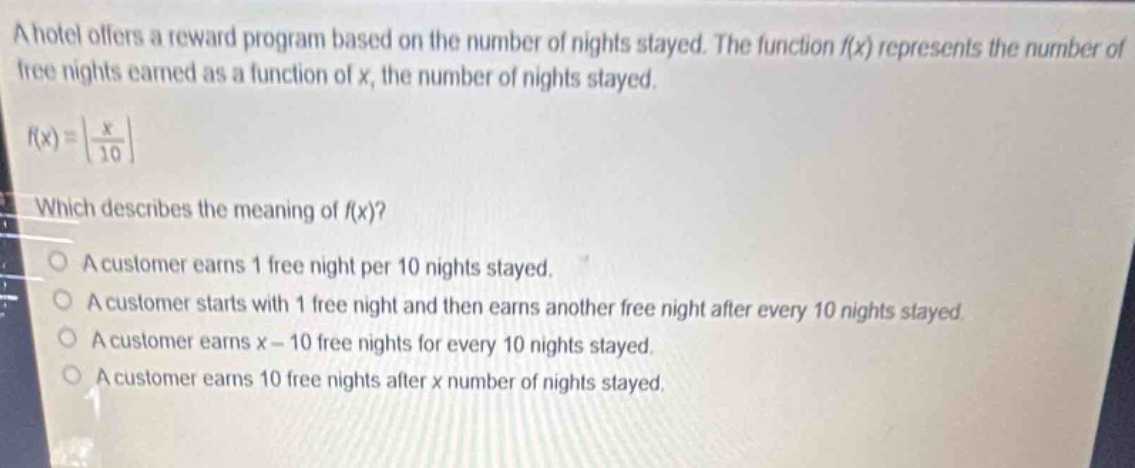
a hotel offers a reward program based on the number of nights stayed. the function (f(x)) represents the number of free nights earned as a function of (x), the number of nights stayed.\n(f(x)=leftlfloor\frac{x}{10}\right\rfloor)\nwhich describes the meaning of (f(x))?\na customer earns 1 free night per 10 nights stayed.\na customer starts with 1 free night and then earns another free night after every 10 nights stayed.\na customer earns (x - 10) free nights for every 10 nights stayed.\na customer earns 10 free nights after (x) number of nights stayed.
Answer
Brief Explanations:
The function $f(x)=\left\lfloor\frac{x}{10}\right\rfloor$ divides the number of nights stayed $x$ by 10 and takes the floor value. This means for every 10 nights stayed, a customer earns 1 free night. For example, if $x = 10$, $\left\lfloor\frac{10}{10}\right\rfloor=1$; if $x = 19$, $\left\lfloor\frac{19}{10}\right\rfloor = 1$.
Answer:
A. A customer earns 1 free night per 10 nights stayed.