the monthly sales s (in hundreds of units) of skiing equipment at a sports store are approximated by s =…
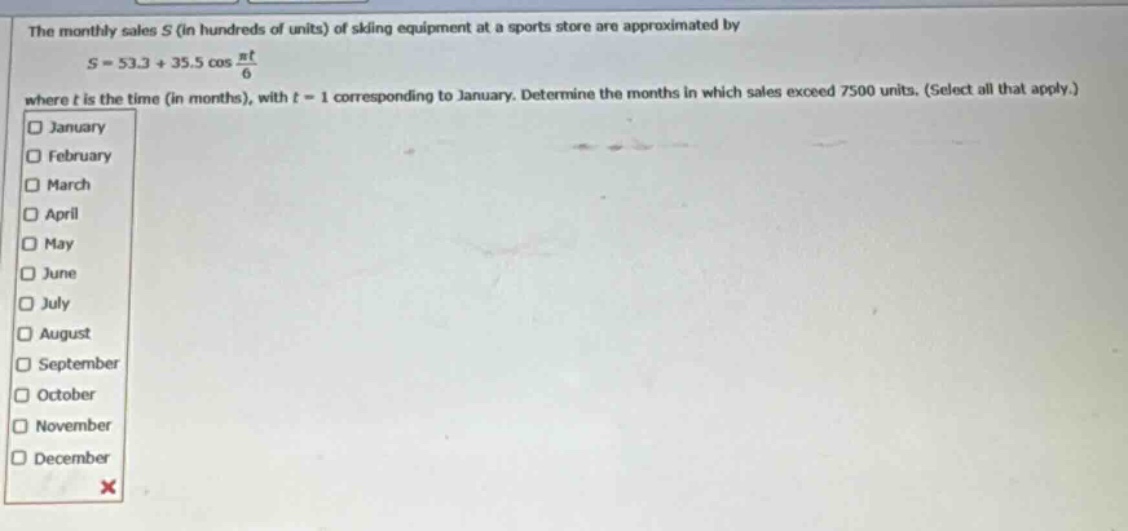
the monthly sales s (in hundreds of units) of skiing equipment at a sports store are approximated by s = 53.3 + 35.5 cos(πt/6) where t is the time (in months), with t = 1 corresponding to january. determine the months in which sales exceed 7500 units. (select all that apply.) january february march april may june july august september october november december
Answer
Explanation:
Step1: Set up the inequality
Since $S$ is in hundreds of units and we want sales to exceed 7500 units, we set $S>75$. So, $53.3 + 35.5\cos\frac{\pi t}{6}>75$.
Step2: Isolate the cosine - term
Subtract 53.3 from both sides of the inequality: $35.5\cos\frac{\pi t}{6}>75 - 53.3$, which simplifies to $35.5\cos\frac{\pi t}{6}>21.7$. Then, divide both sides by 35.5: $\cos\frac{\pi t}{6}>\frac{21.7}{35.5}\approx0.611$.
Step3: Find the range of $t$
We know that if $\cos x > 0.611$, then $- \cos^{-1}(0.611)<x<\cos^{-1}(0.611)$. Since $\cos^{-1}(0.611)\approx0.905$ radians, we have $- 0.905<\frac{\pi t}{6}<0.905$. Also, considering the periodicity of the cosine function $y = \cos x$ with period $2\pi$, we have $2k\pi-0.905<\frac{\pi t}{6}<2k\pi + 0.905,k\in\mathbb{Z}$. For $k = 0$: Multiply through by $\frac{6}{\pi}$: $- \frac{6\times0.905}{\pi}<t<\frac{6\times0.905}{\pi}$. $- \frac{5.43}{\pi}<t<\frac{5.43}{\pi}\approx1.73$. For $k = 1$: $2\pi-0.905<\frac{\pi t}{6}<2\pi + 0.905$. Multiply through by $\frac{6}{\pi}$: $12-\frac{6\times0.905}{\pi}<t<12+\frac{6\times0.905}{\pi}$. $12 - 1.73<t<12 + 1.73$, or $10.27<t<13.73$. Since $t$ represents months and $1\leq t\leq12$, the values of $t$ that satisfy the inequality are $t = 1$ (January) and $t = 11$ (November).
Answer:
January, November