the owner of a catering company wants to select a random sample of clients to find out about their food…
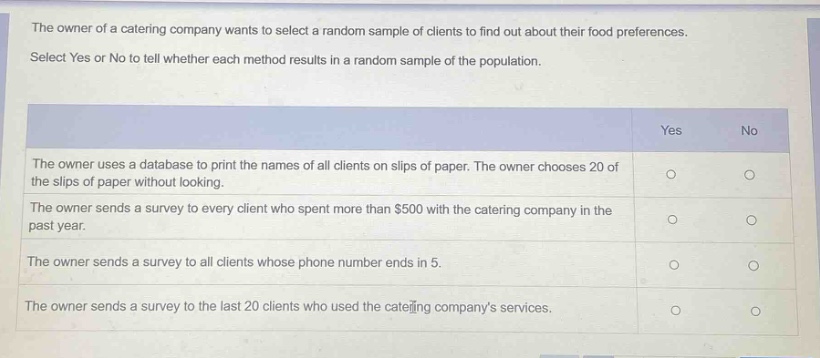
the owner of a catering company wants to select a random sample of clients to find out about their food preferences. select yes or no to tell whether each method results in a random sample of the population. the owner uses a database to print the names of all clients on slips of paper. the owner chooses 20 of the slips of paper without looking. the owner sends a survey to every client who spent more than $500 with the catering company in the past year. the owner sends a survey to all clients whose phone number ends in 5. the owner sends a survey to the last 20 clients who used the catering companys services.
Answer
Brief Explanations:
- When the owner prints all client names on slips and chooses 20 without looking, each client has an equal chance of being selected, so it's a random sample.
- Sending a survey only to clients who spent more than $500 in the past year is a non - random sample as it only includes a specific subset of clients based on a spending criterion.
- Sending a survey to all clients whose phone number ends in 5 is non - random as it selects clients based on a phone number characteristic rather than randomly.
- Sending a survey to the last 20 clients is non - random as it only includes clients from a particular recent time period and not randomly from the entire population.
Answer:
- Yes
- No
- No
- No