part b blair purchases the t - shirts from company b. she needs to add a 75% markup to her total cost to…
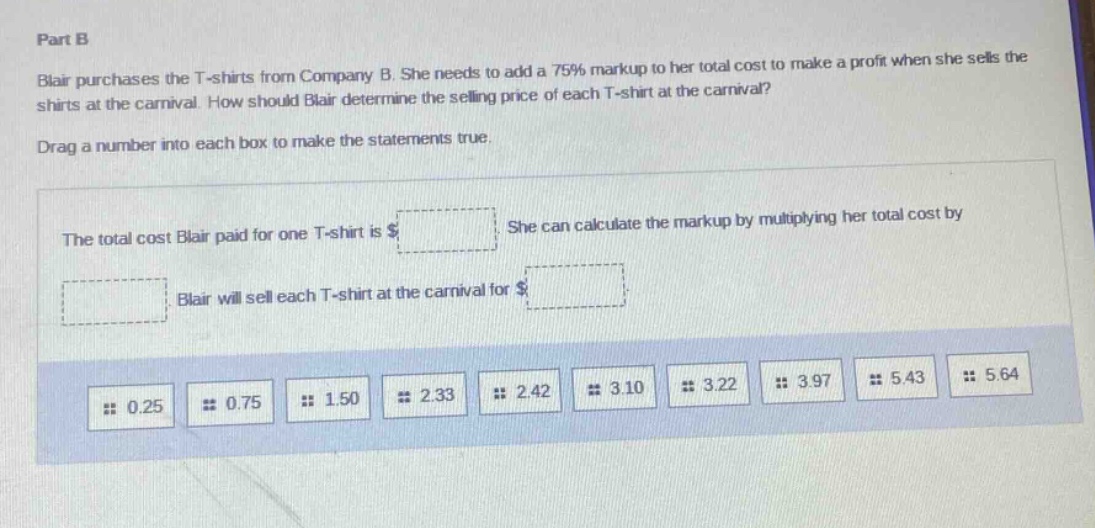
part b blair purchases the t - shirts from company b. she needs to add a 75% markup to her total cost to make a profit when she sells the shirts at the carnival. how should blair determine the selling price of each t - shirt at the carnival? drag a number into each box to make the statements true. the total cost blair paid for one t - shirt is $ she can calculate the markup by multiplying her total cost by. blair will sell each t - shirt at the carnival for $ 0.25 0.75 1.50 2.33 2.42 3.10 3.22 3.97 5.43 5.64
Answer
Explanation:
Step1: Identify markup rate
The markup rate is 75% or 0.75 in decimal form.
Step2: Let the cost - price of one T - shirt be $x$.
The markup amount is $0.75x$.
Step3: Calculate selling price
The selling price $S$ of one T - shirt is $S=x + 0.75x=1.75x$. But we need to assume a cost - price value from the given options to complete the calculation. Let's assume the cost - price of one T - shirt $x = 2.42$ (we assume this value as it is one of the options). The markup amount is $0.75\times2.42 = 1.815$. The selling price is $2.42+1.815 = 4.235$ which is not in the options. Let's work backward. If we assume the selling price formula $S=(1 + 0.75)x=1.75x$. If we assume $x = 3.10$, then the markup amount is $0.75\times3.10 = 2.325\approx2.33$ (approximate to the option value), and the selling price is $3.10+2.33 = 5.43$.
Answer:
The total cost Blair paid for one T - shirt is $3.10$. She can calculate the markup by multiplying her total cost by $0.75$. Blair will sell each T - shirt at the carnival for $5.43$.