9. what is the primary characteristic of economy pricing? a) setting premium prices b) minimizing costs to…
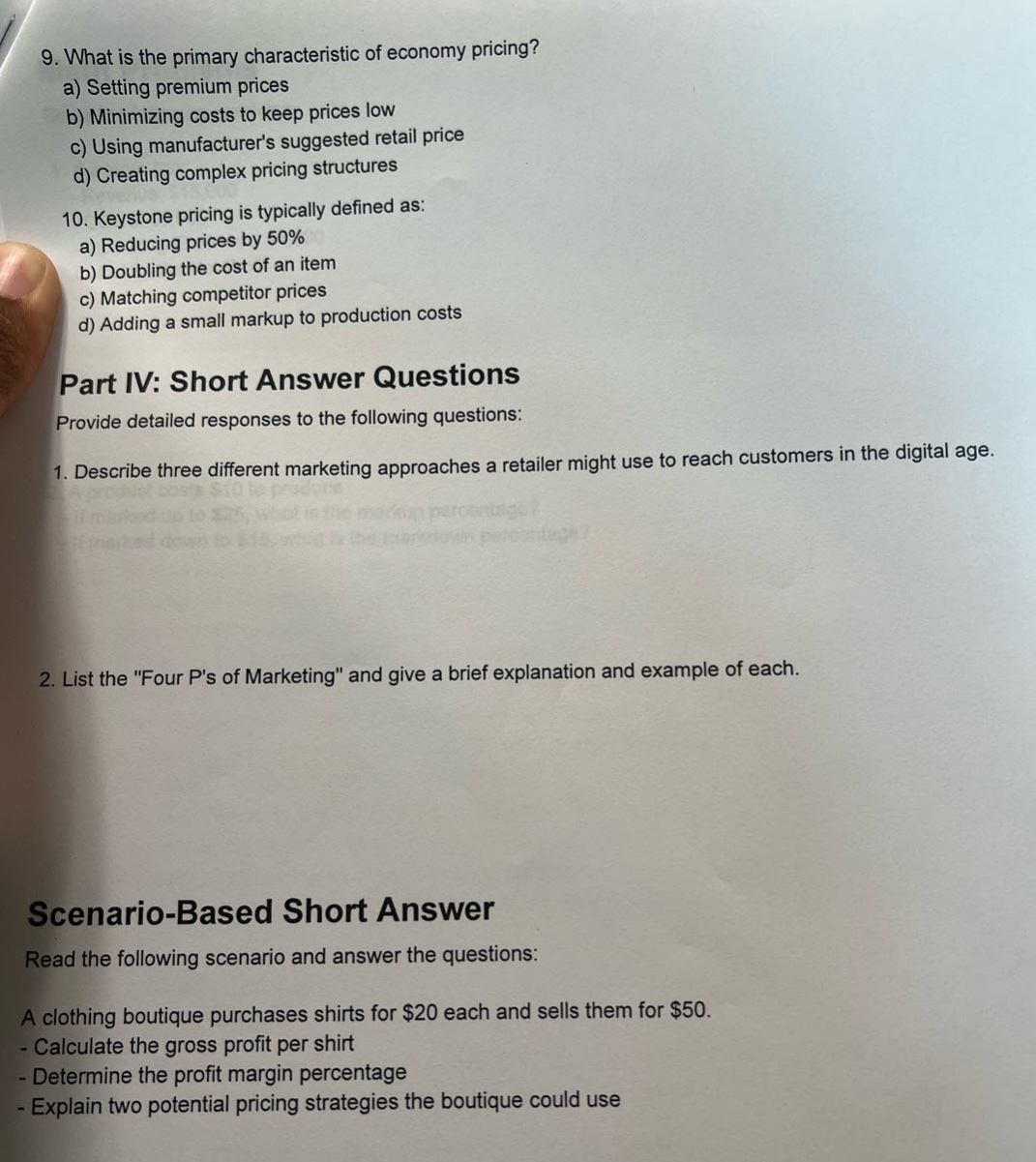
9. what is the primary characteristic of economy pricing? a) setting premium prices b) minimizing costs to keep prices low c) using manufacturers suggested retail price d) creating complex pricing structures 10. keystone pricing is typically defined as: a) reducing prices by 50% b) doubling the cost of an item c) matching competitor prices d) adding a small markup to production costs part iv: short answer questions provide detailed responses to the following questions: 1. describe three different marketing approaches a retailer might use to reach customers in the digital age. 2. list the \four ps of marketing\ and give a brief explanation and example of each. scenario - based short answer read the following scenario and answer the questions: a clothing boutique purchases shirts for $20 each and sells them for $50. - calculate the gross profit per shirt - determine the profit margin percentage - explain two potential pricing strategies the boutique could use
Answer
Answer:
Question 9:
b) Minimizing costs to keep prices low
Question 10:
b) Doubling the cost of an item
Part IV - Question 1:
Three marketing approaches a retailer might use in the digital - age:
- Social Media Marketing: Using platforms like Facebook, Instagram, and Twitter to promote products, engage with customers, and run targeted ads. For example, a clothing retailer can post high - quality images of new collections on Instagram and use influencer partnerships to reach a wider audience.
- Email Marketing: Sending personalized product recommendations, discounts, and new arrival notifications to customers who have subscribed to the retailer's email list. For instance, a beauty retailer might send an email with exclusive offers on new makeup launches to its loyal customers.
- Search Engine Marketing (SEM): Pay - per - click (PPC) advertising on search engines like Google. When a customer searches for relevant keywords (e.g., "running shoes"), the retailer's ads can appear at the top of the search results. A sports retailer can use SEM to drive traffic to its website when customers are actively looking for sports products.
Part IV - Question 2:
The "Four P's of Marketing" are:
- Product: The item or service being offered. It includes features, quality, design, and packaging. Example: Apple's iPhone. It has advanced features like a high - quality camera, sleek design, and user - friendly interface.
- Price: The amount customers pay for the product. It can be set based on costs, competition, and customer perception of value. Example: A luxury watch brand might price its products high to convey exclusivity and high quality.
- Place: Where the product is sold or distributed. This can include physical stores, online platforms, or a combination. Example: Amazon sells a wide variety of products through its online marketplace, reaching customers globally.
- Promotion: Activities to communicate the product to the target market. This includes advertising, sales promotions, public relations, and personal selling. Example: A soft - drink company might run TV commercials during major sports events to promote its new flavor.
Scenario - Based Short Answer:
- Calculate the gross profit per shirt:
Answer:
$30
Explanation:
Step1: Recall gross profit formula
Gross profit = Selling price - Cost price
Step2: Substitute values
Gross profit = $50 - $20=$30
- Determine the profit margin percentage:
Answer:
60%
Explanation:
Step1: Recall profit margin formula
Profit margin percentage=$\frac{\text{Gross profit}}{\text{Selling price}}\times100%$
Step2: Substitute values
Profit margin percentage = $\frac{30}{50}\times100% = 60%$
- Explain two potential pricing strategies the boutique could use:
- Value - based pricing: This strategy sets prices based on the perceived value of the product to the customer rather than just the cost. For example, if the boutique's shirts are seen as high - quality, fashionable, and exclusive, it can price them higher to match the value customers place on them.
- Dynamic pricing: The boutique can adjust its prices based on factors like demand, time of day, or competitor prices. For instance, during peak shopping seasons or when a particular style is in high demand, it can increase prices, and during slow periods, it can offer discounts to attract more customers.
Brief Explanations:
For multiple - choice questions 9 and 10, the answers are based on standard definitions in marketing and pricing concepts. For the short - answer questions, the responses draw on common marketing knowledge and practices. In the scenario - based part, the calculations follow basic accounting formulas for profit and profit margin, and the pricing strategies are common approaches in retail marketing.