question 3 of 25\na marketing firm tracks data on grocery store visits. in one study, it finds that the…
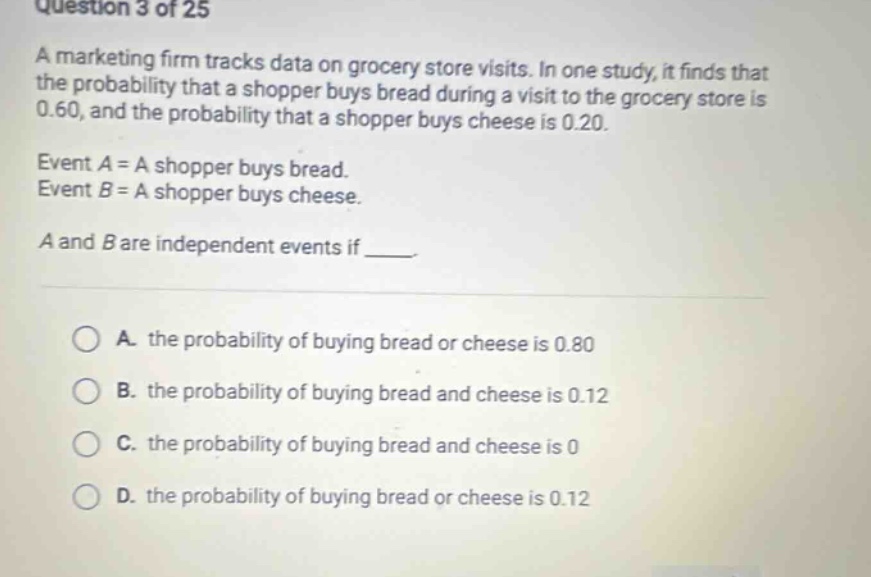
question 3 of 25\na marketing firm tracks data on grocery store visits. in one study, it finds that the probability that a shopper buys bread during a visit to the grocery store is 0.60, and the probability that a shopper buys cheese is 0.20.\nevent a = a shopper buys bread.\nevent b = a shopper buys cheese.\na and b are independent events if ___.\na. the probability of buying bread or cheese is 0.80\nb. the probability of buying bread and cheese is 0.12\nc. the probability of buying bread and cheese is 0\nd. the probability of buying bread or cheese is 0.12
Answer
Explanation:
Step1: Recall independence formula
For two independent events (A) and (B), (P(A\cap B)=P(A)\times P(B)). Given (P(A) = 0.60) and (P(B)=0.20), then (P(A)\times P(B)=0.60\times0.20 = 0.12).
Step2: Analyze each option
- Option A: (P(A\cup B)=P(A)+P(B)) only when (A) and (B) are mutually - exclusive, not independent. (P(A\cup B)=P(A)+P(B)-P(A\cap B)) for general events. Here (P(A)+P(B)=0.60 + 0.20=0.80), but this is not the condition for independence.
- Option B: Since (P(A)\times P(B)=0.12), if (P(A\cap B) = 0.12), then (A) and (B) are independent.
- Option C: (P(A\cap B)=0) means (A) and (B) are mutually - exclusive, not independent.
- Option D: (P(A\cup B)=P(A)+P(B)-P(A\cap B)\neq0.12) for these non - mutually - exclusive events.
Answer:
B. the probability of buying bread and cheese is 0.12