question 7\nusing psychological pricing, a company might charge $400 for a designer item because it:\nis…
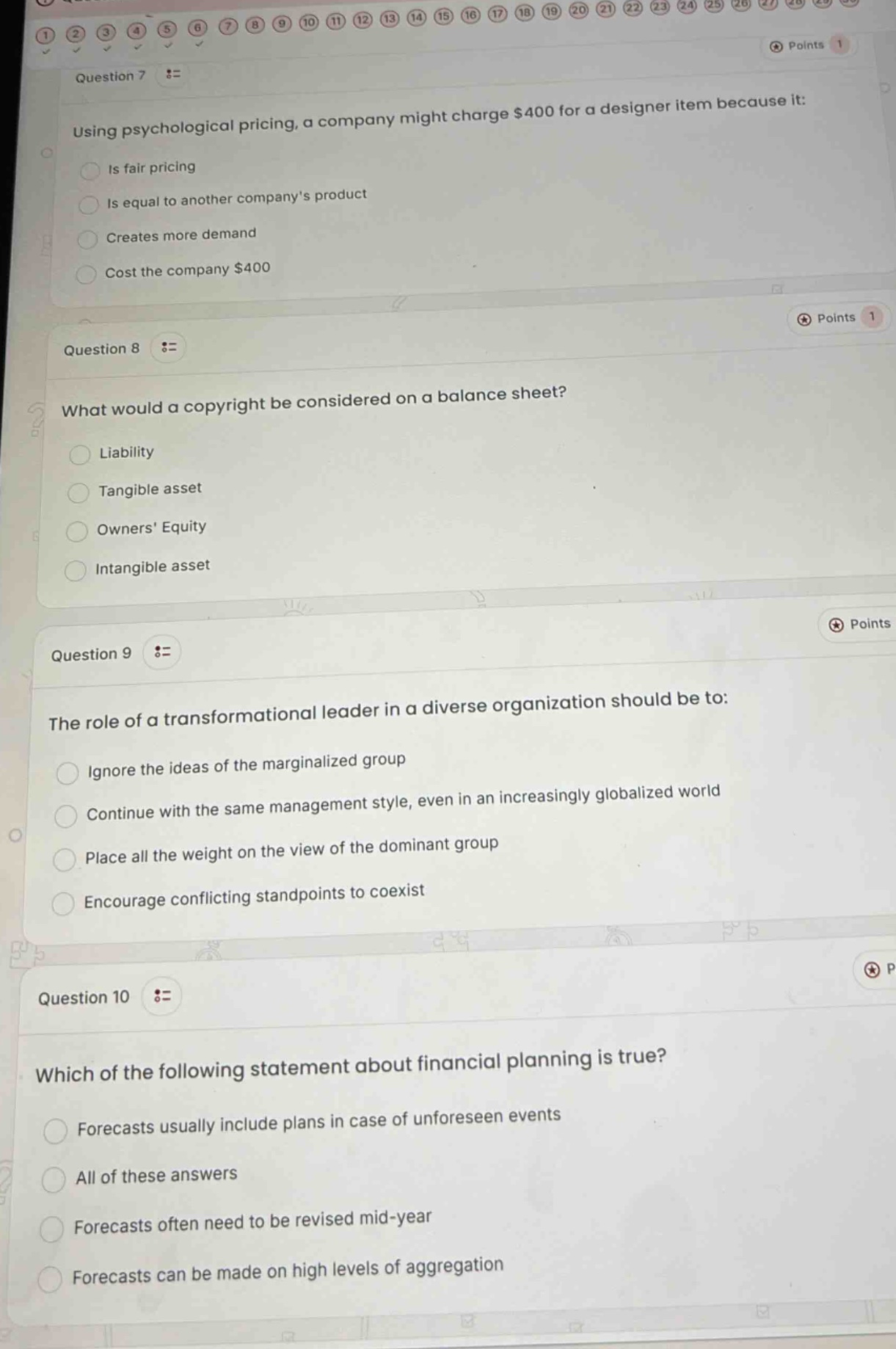
question 7\nusing psychological pricing, a company might charge $400 for a designer item because it:\nis fair pricing\nis equal to another companys product\ncreates more demand\ncost the company $400\n\nquestion 8\nwhat would a copyright be considered on a balance sheet?\nliability\ntangible asset\nowners equity\nintangible asset\n\nquestion 9\nthe role of a transformational leader in a diverse organization should be to:\nignore the ideas of the marginalized group\ncontinue with the same management style, even in an increasingly globalized world\nplace all the weight on the view of the dominant group\nencourage conflicting standpoints to coexist\n\nquestion 10\nwhich of the following statement about financial planning is true?\nforecasts usually include plans in case of unforeseen events\nall of these answers\nforecasts often need to be revised mid - year\nforecasts can be made on high levels of aggregation
Answer
Brief Explanations:
- Question 7: Psychological pricing aims to influence consumer perception and demand. Charging $400 might create more demand as it plays on consumer psychology.
- Question 8: Copyright is an intangible asset as it is a non - physical asset representing legal rights.
- Question 9: A transformational leader in a diverse organization should encourage different viewpoints to coexist to drive positive change.
- Question 10: Financial forecasts can be made at high levels of aggregation, often need mid - year revisions, and may include contingency plans for unforeseen events.
Answer:
- Question 7: C. Creates more demand
- Question 8: D. Intangible asset
- Question 9: D. Encourage conflicting standpoints to coexist
- Question 10: B. All of these answers