1. what is the relationship between selling and the marketing concept? 2. how are e - mails, customer…
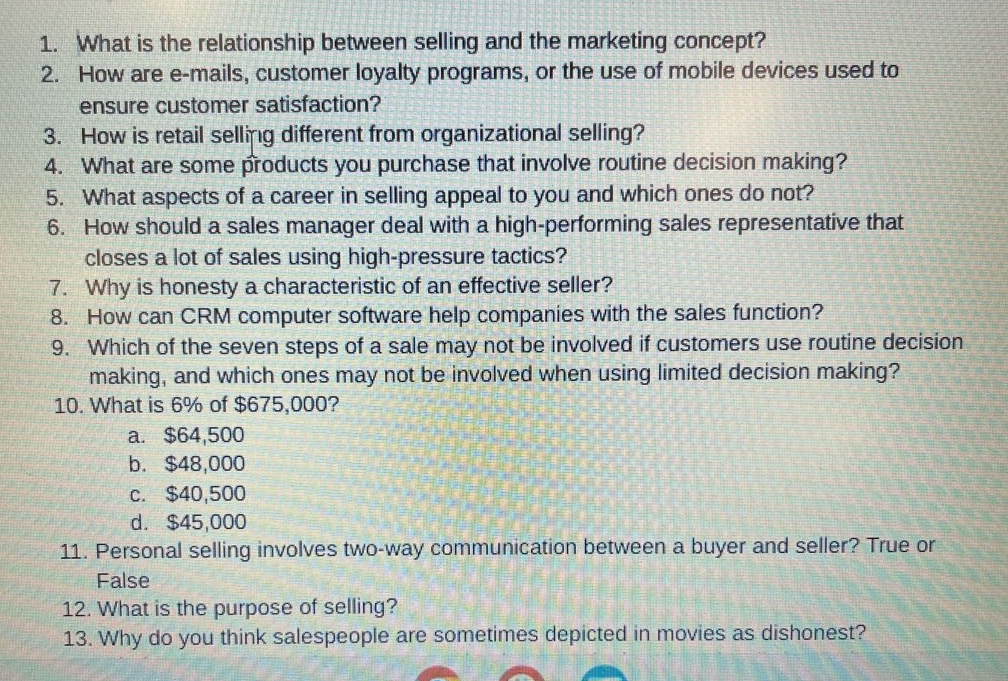
1. what is the relationship between selling and the marketing concept? 2. how are e - mails, customer loyalty programs, or the use of mobile devices used to ensure customer satisfaction? 3. how is retail selling different from organizational selling? 4. what are some products you purchase that involve routine decision making? 5. what aspects of a career in selling appeal to you and which ones do not? 6. how should a sales manager deal with a high - performing sales representative that closes a lot of sales using high - pressure tactics? 7. why is honesty a characteristic of an effective seller? 8. how can crm computer software help companies with the sales function? 9. which of the seven steps of a sale may not be involved if customers use routine decision making, and which ones may not be involved when using limited decision making? 10. what is 6% of $675,000? a. $64,500 b. $48,000 c. $40,500 d. $45,000 11. personal selling involves two - way communication between a buyer and seller? true or false 12. what is the purpose of selling? 13. why do you think salespeople are sometimes depicted in movies as dishonest?
Answer
1.
Brief Explanations:
The marketing concept focuses on customer - centered strategies. Selling is a part of marketing, aiming to convert potential customers into buyers. It's the process of promoting and transferring ownership of products or services.
Answer:
Selling is a component of the marketing concept. Marketing is broader, focusing on customer needs and satisfaction, while selling is the act of persuading customers to buy.
2.
Brief Explanations:
E - mails can be used for personalized communication, customer loyalty programs offer incentives for repeat business, and mobile devices provide convenient access to services, all enhancing customer satisfaction.
Answer:
E - mails allow for personalized communication and follow - up. Customer loyalty programs offer rewards to encourage repeat business. Mobile devices enable easy access to products, services, and support, all contributing to satisfaction.
3.
Brief Explanations:
Retail selling is to end - consumers, usually in small quantities. Organizational selling is to businesses or organizations, often involving larger orders and more complex decision - making processes.
Answer:
Retail selling targets individual consumers for personal use, with smaller transactions and simpler decision - making. Organizational selling targets businesses, with larger orders, longer sales cycles, and more complex decision - making units.
4.
Brief Explanations:
Products like groceries, toiletries, and basic household items often involve routine decision - making as they are frequently purchased and consumers have well - established preferences.
Answer:
Groceries (e.g., bread, milk), toiletries (e.g., toothpaste, soap), and basic household items (e.g., light bulbs) are products that usually involve routine decision - making.
5.
Brief Explanations:
Positive aspects could include high earning potential, meeting new people, and flexibility. Negative aspects might be high stress, rejection, and long working hours.
Answer:
Positive aspects: High earning potential, meeting diverse people. Negative aspects: High stress levels, frequent rejection, long working hours.
6.
Brief Explanations:
The sales manager should have a conversation to discuss ethical selling practices, set clear ethical guidelines, and emphasize long - term customer relationships over short - term gains.
Answer:
The sales manager should have a one - on - one meeting to discuss ethical selling standards, set clear boundaries on sales tactics, and encourage building long - term customer relationships.
7.
Brief Explanations:
Honesty builds trust with customers. Trust is essential for long - term relationships, repeat business, and positive word - of - mouth.
Answer:
Honesty builds trust with customers. Trust leads to customer loyalty, repeat business, and positive referrals, which are crucial for long - term success in selling.
8.
Brief Explanations:
CRM software helps in managing customer data, tracking sales interactions, identifying sales opportunities, and providing insights for better customer service and sales strategies.
Answer:
CRM software stores and analyzes customer data, tracks sales interactions, identifies potential sales opportunities, and enables personalized marketing and better customer service.
9.
Brief Explanations:
In routine decision - making, steps like information search and evaluation of alternatives may be skipped. In limited decision - making, more complex steps like extensive information search and in - depth evaluation may be reduced.
Answer:
In routine decision - making, information search and evaluation of alternatives may not be involved. In limited decision - making, extensive information search and detailed evaluation of multiple alternatives may not be involved.
10.
Explanation:
Step1: Convert the percentage to a decimal
To find 6% of a number, we first convert 6% to a decimal. 6% = 6/100 = 0.06.
Step2: Multiply the decimal by the given number
We multiply 0.06 by $675000$. So, $0.06\times675000 = 40500$.
Answer:
c. $40,500
11.
Brief Explanations:
Personal selling involves direct interaction between the buyer and the seller, where information is exchanged in both directions.
Answer:
True
12.
Brief Explanations:
The purpose of selling is to transfer the ownership of products or services from the seller to the buyer in exchange for value (usually money), while also satisfying customer needs.
Answer:
The purpose of selling is to transfer products or services to customers in exchange for value and to meet customer needs.
13.
Brief Explanations:
Salespeople may be depicted as dishonest in movies for dramatic effect. Also, some real - life unethical sales practices might have contributed to this stereotype.
Answer:
For dramatic effect in movies and due to some real - life unethical sales practices that have created a negative stereotype.