reyna runs a textile company that manufactures t - shirts. the profit, p, made by the company is modeled by…
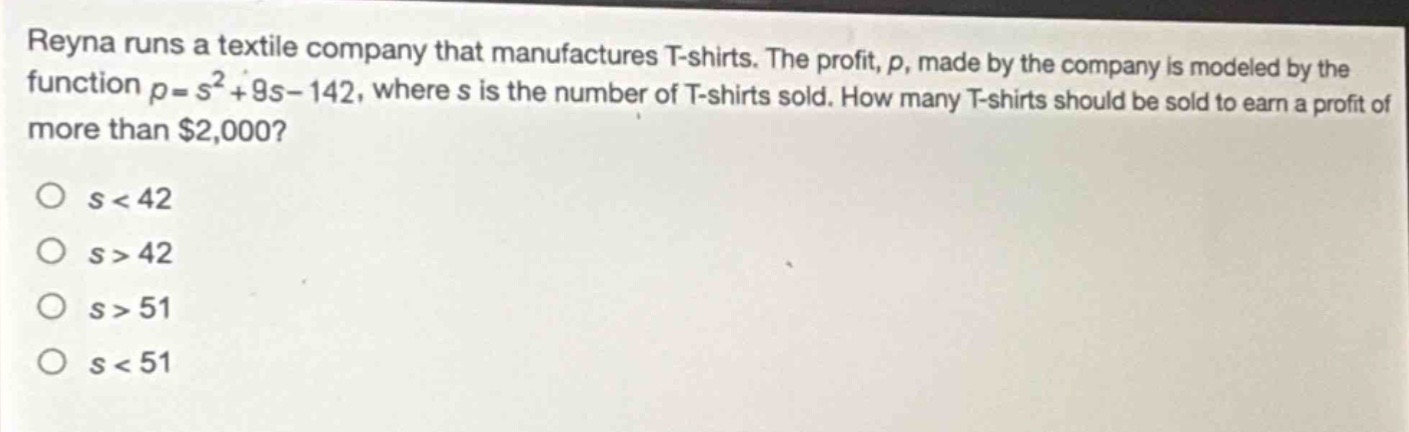
reyna runs a textile company that manufactures t - shirts. the profit, p, made by the company is modeled by the function $p = s^{2}+9s - 142$, where s is the number of t - shirts sold. how many t - shirts should be sold to earn a profit of more than $2,000?\no $s < 42$\no $s > 42$\no $s > 51$\no $s < 51$
Answer
Answer:
B. $s > 42$
Explanation:
Step1: Set up the inequality
We want $p>2000$, so $s^{2}+9s - 142>2000$. Rearranging gives $s^{2}+9s-2142>0$.
Step2: Solve the quadratic equation
For the quadratic equation $s^{2}+9s - 2142 = 0$, where $a = 1$, $b=9$, $c=-2142$. The quadratic formula is $s=\frac{-b\pm\sqrt{b^{2}-4ac}}{2a}$. First, calculate the discriminant $\Delta=b^{2}-4ac=(9)^{2}-4\times1\times(-2142)=81 + 8568=8649$. Then $s=\frac{-9\pm\sqrt{8649}}{2}=\frac{-9\pm93}{2}$. We get two solutions: $s_1=\frac{-9 + 93}{2}=\frac{84}{2}=42$ and $s_2=\frac{-9 - 93}{2}=\frac{-102}{2}=-51$.
Step3: Determine the solution of the inequality
Since the coefficient of $s^{2}$ is positive ($a = 1>0$), the parabola $y=s^{2}+9s - 2142$ opens upward. The inequality $s^{2}+9s - 2142>0$ is satisfied when $s>42$ or $s<-51$. But the number of T - shirts sold $s$ cannot be negative. So the solution is $s>42$.