use the following information to calculate operating cash flow: net income = $200 depreciation expense = $50…
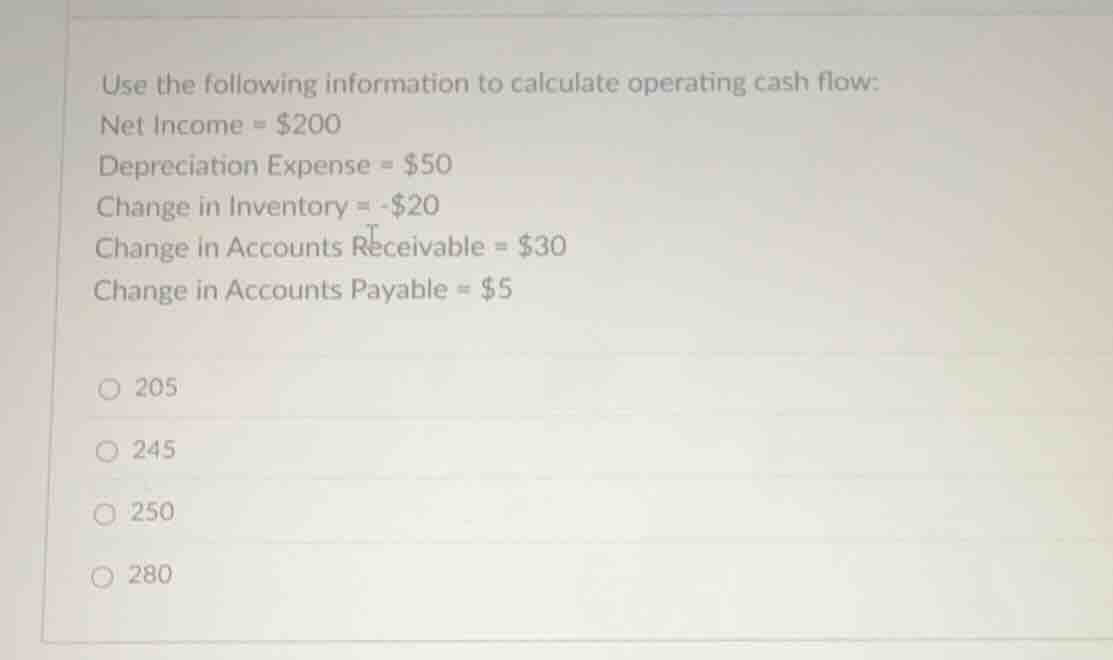
use the following information to calculate operating cash flow: net income = $200 depreciation expense = $50 change in inventory = -$20 change in accounts receivable = $30 change in accounts payable = $5 205 245 250 280
Answer
Explanation:
Step1: Recall the formula for operating cash flow (indirect method)
The formula for operating cash flow using the indirect method is:
Operating Cash Flow = Net Income + Depreciation + (Change in Inventory) + (-Change in Accounts Receivable) + (Change in Accounts Payable)
Wait, let's clarify the adjustments:
- Depreciation is a non - cash expense, so we add it.
- An increase in inventory means we used cash to buy inventory, so a negative change (decrease) in inventory is a cash inflow (we add it).
- An increase in accounts receivable means we sold on credit, so we didn't receive cash, so we subtract the change in accounts receivable.
- An increase in accounts payable means we haven't paid cash, so we add the change in accounts payable.
So the correct formula is:
Operating Cash Flow = Net Income + Depreciation + (Change in Inventory) - (Change in Accounts Receivable) + (Change in Accounts Payable)
Step2: Substitute the values
Given:
Net Income = $200
Depreciation Expense = $50
Change in Inventory = -$20 (which is a decrease, so it's a cash inflow, we add it)
Change in Accounts Receivable = $30 (increase, so we subtract it)
Change in Accounts Payable = $5 (increase, so we add it)
Substitute into the formula:
Operating Cash Flow = 200 + 50+(- 20)-30 + 5
First, calculate 200 + 50 = 250
Then, 250+(-20)=230
Then, 230 - 30 = 200
Then, 200 + 5 = 205? Wait, that can't be right. Wait, maybe I messed up the sign for accounts receivable.
Wait, let's re - examine the indirect method:
The indirect method starts with net income and adjusts for non - cash items and changes in working capital.
Working capital changes:
-
Inventory: If inventory increases, cash decreases (because we used cash to purchase inventory). So a positive change in inventory (increase) is a subtraction, a negative change (decrease) is an addition.
-
Accounts Receivable: If accounts receivable increases, it means we sold on credit, so cash is not received. So an increase in accounts receivable is a subtraction, a decrease is an addition.
-
Accounts Payable: If accounts payable increases, we haven't paid cash, so it's an addition; a decrease is a subtraction.
So the formula is:
Operating Cash Flow = Net Income + Depreciation + ( - Change in Inventory) - (Change in Accounts Receivable) + (Change in Accounts Payable)
Wait, no. Let's use the standard formula:
Operating Cash Flow (Indirect Method) = Net Income + Depreciation + ( - ΔInventory) - ΔAccounts Receivable + ΔAccounts Payable
Wait, ΔInventory is the change in inventory. If ΔInventory is - 20 (decrease), then - ΔInventory is 20.
ΔAccounts Receivable is 30 (increase), so - ΔAccounts Receivable is - 30.
ΔAccounts Payable is 5 (increase), so + ΔAccounts Payable is + 5.
So:
Operating Cash Flow = 200+50 + 20-30 + 5
Calculate step by step:
200 + 50 = 250
250+20 = 270
270 - 30 = 240
240+5 = 245
Ah, I see my mistake earlier. The change in inventory is - 20 (decrease), so when adjusting for working capital, we add the decrease in inventory (because a decrease in inventory means we sold inventory, which is a cash inflow). So the correct adjustment for inventory is + ( - ΔInventory) when ΔInventory is negative? Wait, no. Let's use the formula from accounting:
The change in working capital is (Current Assets - Current Liabilities). Operating cash flow = Net Income + Depreciation - (Change in Current Assets - Change in Current Liabilities)
Current Assets include Inventory and Accounts Receivable. Current Liabilities include Accounts Payable.
So Change in Current Assets = ΔInventory + ΔAccounts Receivable = - 20+30 = 10
Change in Current Liabilities = ΔAccounts Payable = 5
Change in Working Capital = 10 - 5 = 5
Then Operating Cash Flow = Net Income + Depreciation - Change in Working Capital
= 200 + 50-5 = 245
Yes, that's correct. So the formula can also be written as:
Operating Cash Flow = Net Income + Depreciation - (ΔInventory + ΔAccounts Receivable - ΔAccounts Payable)
Let's check:
ΔInventory + ΔAccounts Receivable - ΔAccounts Payable=-20 + 30-5 = 5
Then 200 + 50-5 = 245