10. (10 points) use green’s theorem to find the line integral (oint_{c} (e^{sin(x^{2}+1)}-3y)dx + (cos(1…
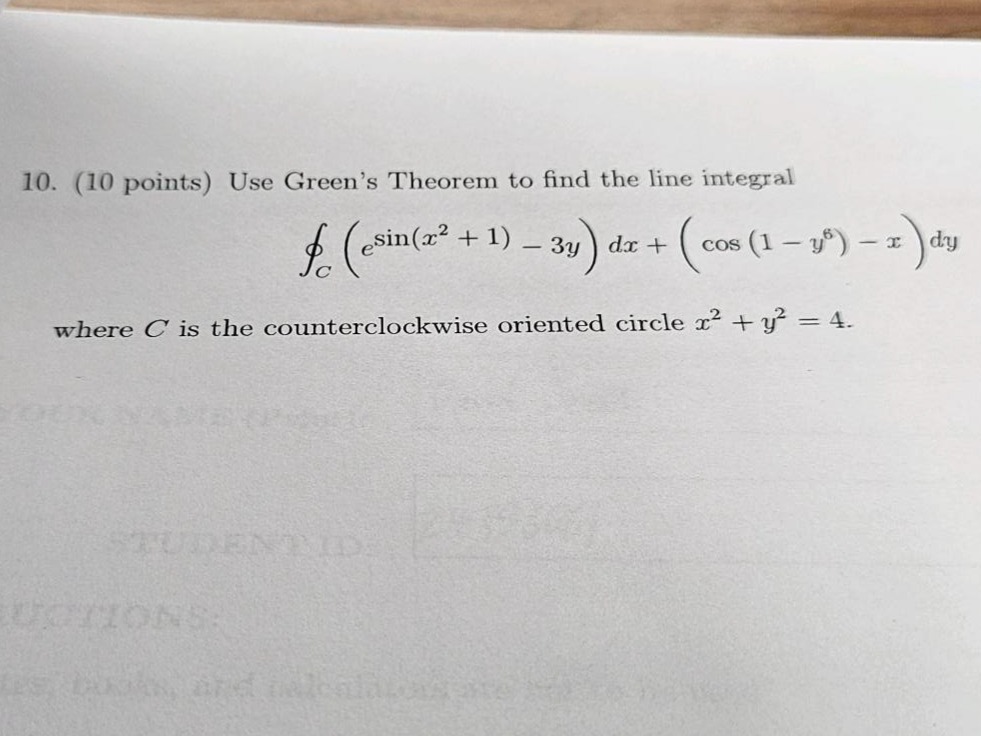
10. (10 points) use green’s theorem to find the line integral (oint_{c} (e^{sin(x^{2}+1)}-3y)dx + (cos(1 - y^{6})-x)dy) where (c) is the counterclockwise oriented circle (x^{2}+y^{2}=4).
Answer
Explanation:
Step1: Recall Green's Theorem
Green's Theorem states that $\oint_{C}Pdx + Qdy=\iint_{D}(\frac{\partial Q}{\partial x}-\frac{\partial P}{\partial y})dA$, where $P = e^{\sin(x^{2}+1)}-3y$, $Q=\cos(1 - y^{6})-x$, and $D$ is the region bounded by the closed - curve $C$. First, find $\frac{\partial Q}{\partial x}$ and $\frac{\partial P}{\partial y}$. $\frac{\partial Q}{\partial x}=- 1$ and $\frac{\partial P}{\partial y}=-3$.
Step2: Calculate $\frac{\partial Q}{\partial x}-\frac{\partial P}{\partial y}$
$\frac{\partial Q}{\partial x}-\frac{\partial P}{\partial y}=-1-(-3)=2$.
Step3: Convert to polar coordinates
The region $D$ is a circle $x^{2}+y^{2}=4$, so in polar coordinates, $x = r\cos\theta$, $y = r\sin\theta$, and $dA = rdr d\theta$. The limits of integration for $r$ are from $0$ to $2$ and for $\theta$ are from $0$ to $2\pi$. The double - integral becomes $\iint_{D}2dA=\int_{0}^{2\pi}\int_{0}^{2}2r drd\theta$.
Step4: Evaluate the double - integral
First, integrate with respect to $r$: $\int_{0}^{2\pi}\left[2\times\frac{r^{2}}{2}\big|{0}^{2}\right]d\theta=\int{0}^{2\pi}(2\times\frac{4 - 0}{2})d\theta=\int_{0}^{2\pi}4d\theta$. Then, integrate with respect to $\theta$: $4\theta\big|_{0}^{2\pi}=8\pi$.
Answer:
$8\pi$