∫10/√(8x - 4x²) dx = \na 20√(8x - 4x²) + c\nb 5sin⁻¹((x - 2)/2) + c\nc 5sin⁻¹(x - 1) + c\nd 5sin⁻¹(x + 1) + c
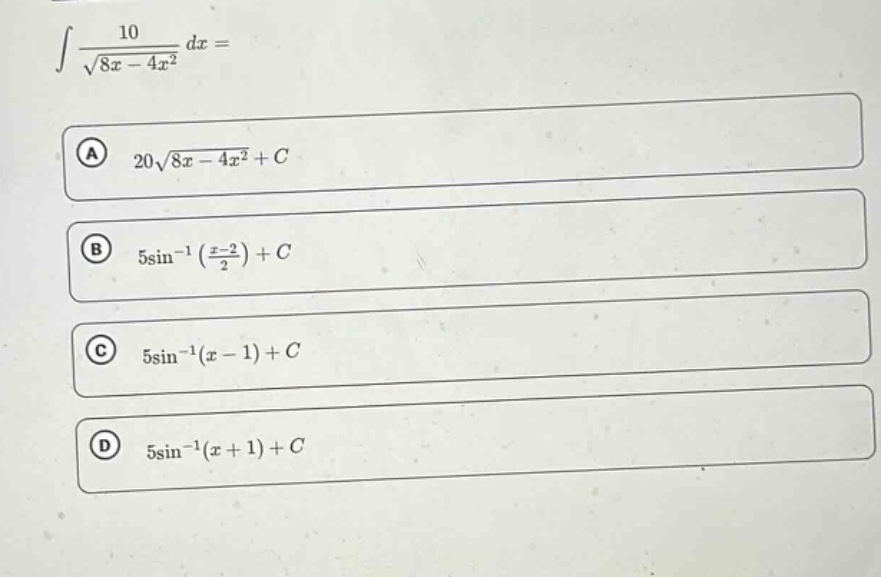
∫10/√(8x - 4x²) dx = \na 20√(8x - 4x²) + c\nb 5sin⁻¹((x - 2)/2) + c\nc 5sin⁻¹(x - 1) + c\nd 5sin⁻¹(x + 1) + c
Answer
Explanation:
Step1: Complete the square for the denominator
First, rewrite $8x - 4x^{2}$ as $-4(x^{2}-2x)$. Completing the square inside the parentheses: $x^{2}-2x=(x - 1)^{2}-1$. So, $8x - 4x^{2}=-4((x - 1)^{2}-1)=4 - 4(x - 1)^{2}$. Then the integral becomes $\int\frac{10}{\sqrt{4-4(x - 1)^{2}}}dx=\int\frac{10}{2\sqrt{1-(x - 1)^{2}}}dx = 5\int\frac{1}{\sqrt{1-(x - 1)^{2}}}dx$.
Step2: Use the integral formula
Recall the integral formula $\int\frac{1}{\sqrt{1 - u^{2}}}du=\sin^{-1}(u)+C$. Let $u=x - 1$, then $5\int\frac{1}{\sqrt{1-(x - 1)^{2}}}dx=5\sin^{-1}(x - 1)+C$.
Answer:
C. $5\sin^{-1}(x - 1)+C$