10. for the curve $y = \\frac{x^{2}+12}{2x + 1}$ determine each of the following and use all of the…
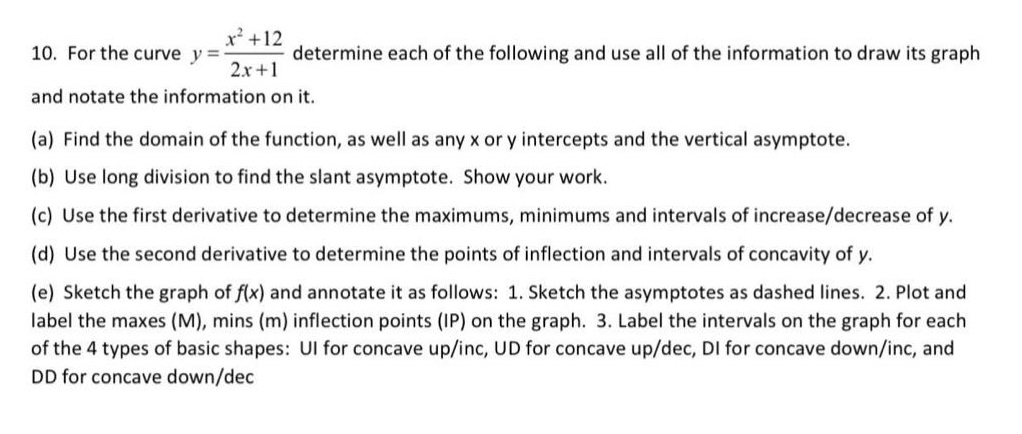
10. for the curve $y = \\frac{x^{2}+12}{2x + 1}$ determine each of the following and use all of the information to draw its graph and notate the information on it.\n(a) find the domain of the function, as well as any x or y intercepts and the vertical asymptote.\n(b) use long division to find the slant asymptote. show your work.\n(c) use the first derivative to determine the maximums, minimums and intervals of increase/decrease of y.\n(d) use the second derivative to determine the points of inflection and intervals of concavity of y.\n(e) sketch the graph of $f(x)$ and annotate it as follows: 1. sketch the asymptotes as dashed lines. 2. plot and label the maxes (m), mins (m) inflection points (ip) on the graph. 3. label the intervals on the graph for each of the 4 types of basic shapes: ui for concave up/inc, ud for concave up/dec, di for concave down/inc, and dd for concave down/dec
Answer
Explanation:
Step1: Find domain, intercepts and vertical asymptote
The function is $y = \frac{x^{2}+12}{2x + 1}$. The denominator cannot be zero. So, $2x+1\neq0$, which gives $x\neq-\frac{1}{2}$. Thus, the domain is $(-\infty,-\frac{1}{2})\cup(-\frac{1}{2},\infty)$. For $x -$intercept, set $y = 0$, then $x^{2}+12=0$, no real - solutions. For $y -$intercept, set $x = 0$, then $y=\frac{0 + 12}{0+1}=12$. The vertical asymptote is $x=-\frac{1}{2}$ since the denominator is zero at $x =-\frac{1}{2}$ and the numerator is non - zero at that point.
Step2: Find slant asymptote using long division
Dividing $x^{2}+12$ by $2x + 1$: [ \begin{align*} \frac{x^{2}+12}{2x + 1}&=\frac{\frac{1}{2}x(2x + 1)-\frac{1}{2}x+12}{2x + 1}\ &=\frac{1}{2}x+\frac{-\frac{1}{2}x + 12}{2x+1}\ &=\frac{1}{2}x-\frac{1}{4}+\frac{12+\frac{1}{4}}{2x + 1}\ &=\frac{1}{2}x-\frac{1}{4}+\frac{\frac{49}{4}}{2x + 1} \end{align*} ] As $x\to\pm\infty$, the slant asymptote is $y=\frac{1}{2}x-\frac{1}{4}$.
Step3: Find first derivative and analyze
First, use the quotient rule. If $y=\frac{u}{v}$ where $u=x^{2}+12$ and $v = 2x+1$, then $u'=2x$ and $v'=2$. [ y'=\frac{u'v - uv'}{v^{2}}=\frac{2x(2x + 1)-2(x^{2}+12)}{(2x + 1)^{2}}=\frac{4x^{2}+2x-2x^{2}-24}{(2x + 1)^{2}}=\frac{2x^{2}+2x - 24}{(2x + 1)^{2}}=\frac{2(x^{2}+x - 12)}{(2x + 1)^{2}}=\frac{2(x + 4)(x - 3)}{(2x + 1)^{2}} ] Set $y'=0$, then $x=-4$ or $x = 3$. The critical points are $x=-4$ and $x = 3$. We consider the intervals $(-\infty,-4)$, $(-4,-\frac{1}{2})$, $(-\frac{1}{2},3)$ and $(3,\infty)$. Test points: For $x=-5$, $y'=\frac{2(-5 + 4)(-5 - 3)}{(-10 + 1)^{2}}=\frac{2\times(-1)\times(-8)}{81}>0$. For $x=-\frac{5}{4}$, $y'=\frac{2(-\frac{5}{4}+4)(-\frac{5}{4}-3)}{(-\frac{5}{2}+1)^{2}}<0$. For $x = 0$, $y'=\frac{2(0 + 4)(0 - 3)}{(0 + 1)^{2}}<0$. For $x = 4$, $y'=\frac{2(4 + 4)(4 - 3)}{(8 + 1)^{2}}>0$. The function is increasing on $(-\infty,-4)\cup(3,\infty)$ and decreasing on $(-4,-\frac{1}{2})\cup(-\frac{1}{2},3)$. $x=-4$ is a local maximum and $y(-4)=\frac{(-4)^{2}+12}{2(-4)+1}=\frac{16 + 12}{-8 + 1}=-\frac{28}{7}=-4$. $x = 3$ is a local minimum and $y(3)=\frac{3^{2}+12}{2\times3+1}=\frac{9+12}{6 + 1}=3$.
Step4: Find second derivative and analyze
[ \begin{align*} y'&=\frac{2x^{2}+2x - 24}{(2x + 1)^{2}}\ y''&=\frac{(4x + 2)(2x + 1)^{2}-2(2x + 1)\times2(2x^{2}+2x - 24)}{(2x + 1)^{4}}\ &=\frac{(4x + 2)(2x + 1)-4(2x^{2}+2x - 24)}{(2x + 1)^{3}}\ &=\frac{8x^{2}+4x+4x + 2-(8x^{2}+8x - 96)}{(2x + 1)^{3}}\ &=\frac{8x^{2}+8x + 2-8x^{2}-8x + 96}{(2x + 1)^{3}}\ &=\frac{98}{(2x + 1)^{3}} \end{align*} ] Set $y'' = 0$, no solutions. But $y''$ is undefined at $x=-\frac{1}{2}$. For $x<-\frac{1}{2}$, $y''<0$, the function is concave down. For $x>-\frac{1}{2}$, $y''>0$, the function is concave up. There are no inflection points.
Step5: Sketch the graph
Sketch the vertical asymptote $x =-\frac{1}{2}$ and the slant asymptote $y=\frac{1}{2}x-\frac{1}{4}$ as dashed lines. Plot the local maximum at $(-4,-4)$, local minimum at $(3,3)$ and $y -$intercept at $(0,12)$. Label the intervals of increase/decrease and concavity as described in the problem.
Answer:
(a) Domain: $(-\infty,-\frac{1}{2})\cup(-\frac{1}{2},\infty)$; $x -$intercept: None; $y -$intercept: $(0,12)$; Vertical asymptote: $x=-\frac{1}{2}$ (b) Slant asymptote: $y=\frac{1}{2}x-\frac{1}{4}$ (c) Local maximum at $(-4,-4)$, local minimum at $(3,3)$; Increasing on $(-\infty,-4)\cup(3,\infty)$, decreasing on $(-4,-\frac{1}{2})\cup(-\frac{1}{2},3)$ (d) Concave down on $(-\infty,-\frac{1}{2})$, concave up on $(-\frac{1}{2},\infty)$, no inflection points (e) Graph is sketched with asymptotes as dashed lines, local max/min and inflection - related intervals labeled as per instructions.