10. determine where the function is concave upward and where it is concave downward. use interval notation…
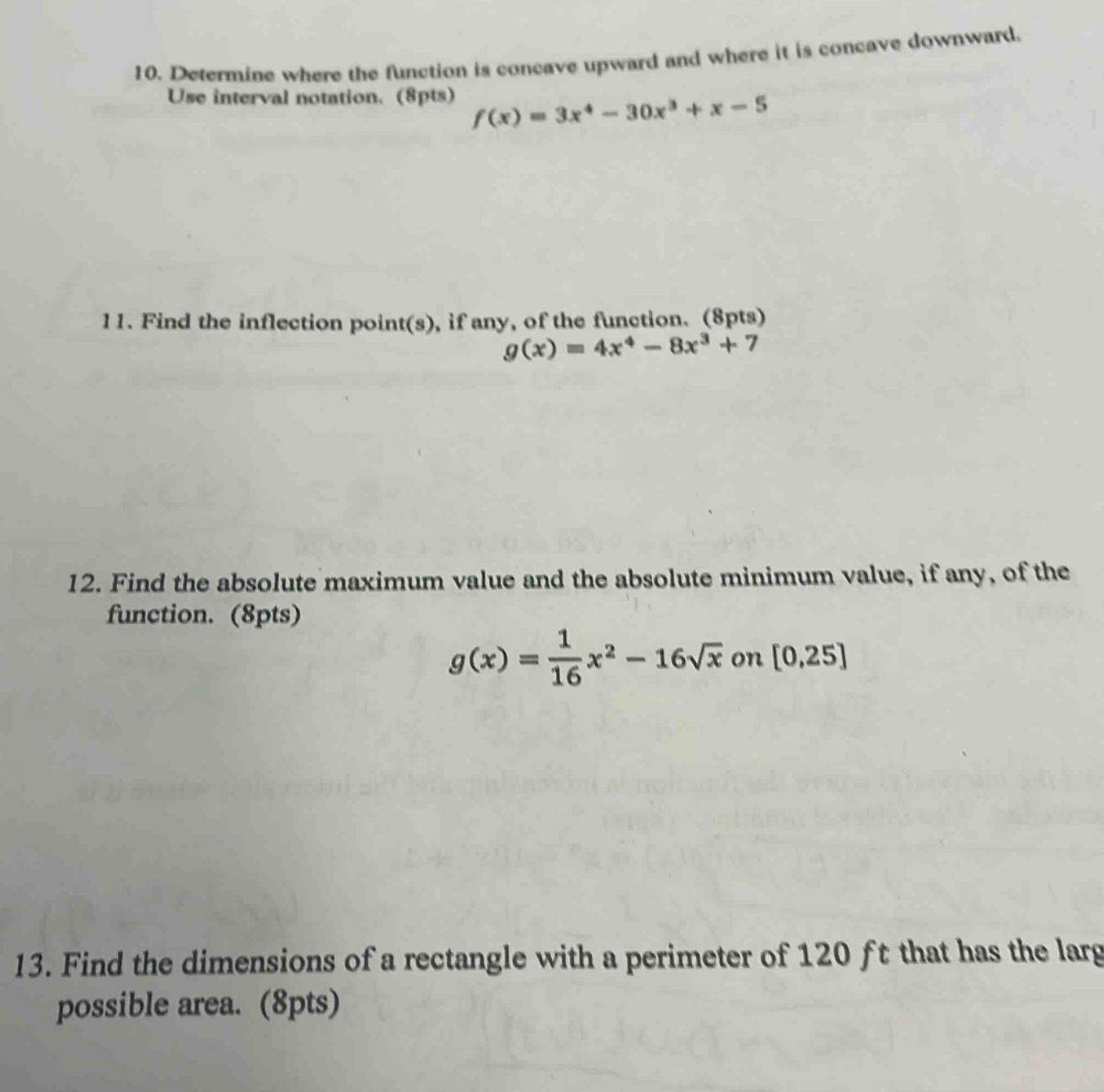
10. determine where the function is concave upward and where it is concave downward. use interval notation. (8pts) $f(x)=3x^{4}-30x^{3}+x - 5$\n11. find the inflection point(s), if any, of the function. (8pts) $g(x)=4x^{4}-8x^{3}+7$\n12. find the absolute maximum value and the absolute minimum value, if any, of the function. (8pts) $g(x)=\frac{1}{16}x^{2}-16sqrt{x}$ on $0,25$\n13. find the dimensions of a rectangle with a perimeter of 120 ft that has the largest possible area. (8pts)
Answer
10.
Explanation:
Step1: Find the first - derivative
Using the power rule $(x^n)'=nx^{n - 1}$, for $f(x)=3x^{4}-30x^{3}+x - 5$, we have $f'(x)=12x^{3}-90x^{2}+1$.
Step2: Find the second - derivative
Differentiate $f'(x)$ again. $f''(x)=36x^{2}-180x=36x(x - 5)$.
Step3: Find the inflection points
Set $f''(x)=0$. So $36x(x - 5)=0$, which gives $x = 0$ and $x = 5$.
Step4: Test the intervals
Choose test points in the intervals $(-\infty,0)$, $(0,5)$ and $(5,\infty)$. For $x=-1$, $f''(-1)=36\times(-1)\times(-1 - 5)=216>0$, so $f(x)$ is concave upward on $(-\infty,0)$. For $x = 1$, $f''(1)=36\times1\times(1 - 5)=-144<0$, so $f(x)$ is concave downward on $(0,5)$. For $x = 6$, $f''(6)=36\times6\times(6 - 5)=216>0$, so $f(x)$ is concave upward on $(5,\infty)$.
Answer:
Concave upward: $(-\infty,0)\cup(5,\infty)$; Concave downward: $(0,5)$
11.
Explanation:
Step1: Find the first - derivative
For $g(x)=4x^{4}-8x^{3}+7$, using the power rule, $g'(x)=16x^{3}-24x^{2}$.
Step2: Find the second - derivative
Differentiate $g'(x)$: $g''(x)=48x^{2}-48x=48x(x - 1)$.
Step3: Find the inflection points
Set $g''(x)=0$. Then $48x(x - 1)=0$, which gives $x = 0$ and $x = 1$. Substitute $x = 0$ and $x = 1$ into $g(x)$: $g(0)=4\times0^{4}-8\times0^{3}+7 = 7$ and $g(1)=4\times1^{4}-8\times1^{3}+7=3$.
Answer:
The inflection points are $(0,7)$ and $(1,3)$
12.
Explanation:
Step1: Find the derivative
For $g(x)=\frac{1}{16}x^{2}-16\sqrt{x}=\frac{1}{16}x^{2}-16x^{\frac{1}{2}}$, using the power rule, $g'(x)=\frac{1}{8}x-\frac{8}{\sqrt{x}}=\frac{x^{\frac{3}{2}}-64}{8\sqrt{x}}$.
Step2: Find the critical points
Set $g'(x)=0$, then $x^{\frac{3}{2}}-64 = 0$, so $x^{\frac{3}{2}}=64$ and $x = 16$. Also, $g'(x)$ is undefined at $x = 0$.
Step3: Evaluate the function at critical and endpoints
$g(0)=\frac{1}{16}\times0^{2}-16\sqrt{0}=0$. $g(16)=\frac{1}{16}\times16^{2}-16\sqrt{16}=16 - 64=-48$. $g(25)=\frac{1}{16}\times25^{2}-16\sqrt{25}=\frac{625}{16}-80=\frac{625 - 1280}{16}=-\frac{655}{16}\approx - 40.94$.
Answer:
Absolute maximum value is $0$ at $x = 0$; Absolute minimum value is $-48$ at $x = 16$
13.
Explanation:
Step1: Let the dimensions of the rectangle
Let the length be $x$ and the width be $y$. The perimeter $P = 2x+2y=120$, so $y = 60 - x$.
Step2: Express the area function
The area $A=xy=x(60 - x)=60x - x^{2}$.
Step3: Find the derivative of the area function
$A'(x)=60 - 2x$.
Step4: Find the critical point
Set $A'(x)=0$, then $60 - 2x=0$, which gives $x = 30$.
Step5: Find the second - derivative
$A''(x)=-2<0$, so $x = 30$ is a maximum. When $x = 30$, $y=60 - 30 = 30$.
Answer:
The dimensions are $30$ ft by $30$ ft.