a 10 - foot ladder is leaning against a vertical wall (see figure) when jack begins pulling the foot of the…
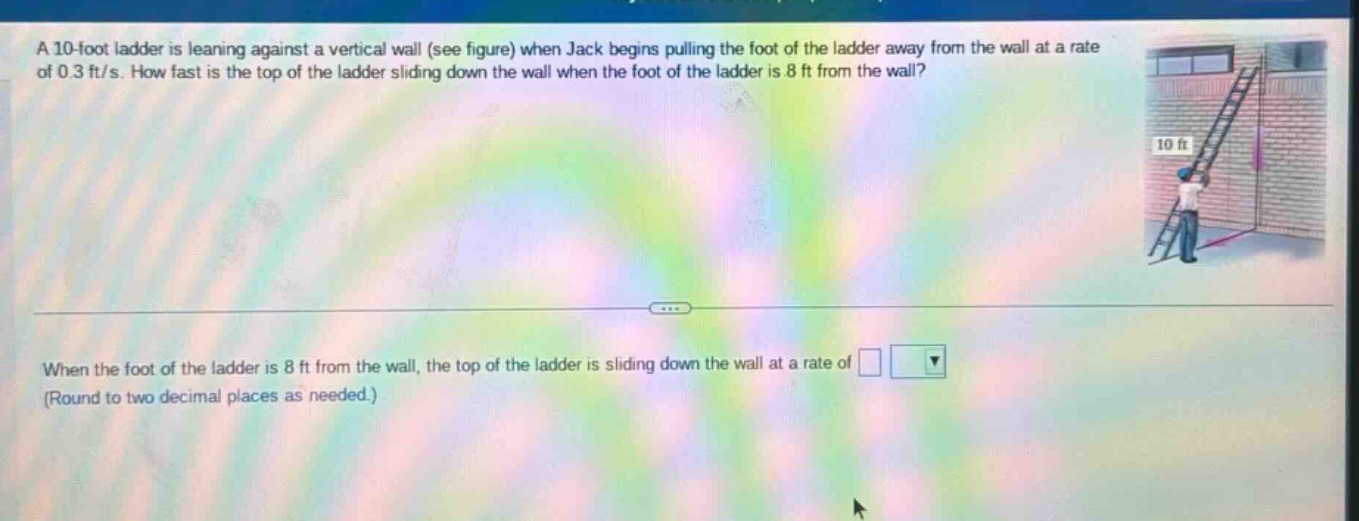
a 10 - foot ladder is leaning against a vertical wall (see figure) when jack begins pulling the foot of the ladder away from the wall at a rate of 0.3 ft/s. how fast is the top of the ladder sliding down the wall when the foot of the ladder is 8 ft from the wall? when the foot of the ladder is 8 ft from the wall, the top of the ladder is sliding down the wall at a rate of (round to two decimal places as needed.)
Answer
Explanation:
Step1: Establish the relationship
Let $x$ be the distance of the foot of the ladder from the wall and $y$ be the distance of the top of the ladder from the ground. By the Pythagorean - theorem, $x^{2}+y^{2}=10^{2}=100$.
Step2: Differentiate with respect to time $t$
Differentiating both sides of the equation $x^{2}+y^{2}=100$ with respect to $t$, we get $2x\frac{dx}{dt}+2y\frac{dy}{dt}=0$. Then simplify it to $x\frac{dx}{dt}+y\frac{dy}{dt}=0$.
Step3: Find $y$ when $x = 8$
When $x = 8$, from $x^{2}+y^{2}=100$, we have $8^{2}+y^{2}=100$, so $y^{2}=100 - 64=36$, and $y = 6$ (since $y>0$).
Step4: Substitute known values
We know that $\frac{dx}{dt}=0.3$ ft/s, $x = 8$, and $y = 6$. Substitute these values into $x\frac{dx}{dt}+y\frac{dy}{dt}=0$. We get $8\times0.3+6\times\frac{dy}{dt}=0$.
Step5: Solve for $\frac{dy}{dt}$
First, calculate $8\times0.3 = 2.4$. Then the equation becomes $2.4+6\times\frac{dy}{dt}=0$. Subtract 2.4 from both sides: $6\times\frac{dy}{dt}=-2.4$. Divide both sides by 6: $\frac{dy}{dt}=-0.40$ ft/s.
Answer:
$-0.40$ ft/s