a 10 - foot ladder is leaning straight up against a wall when a person begins pulling the base of the ladder…
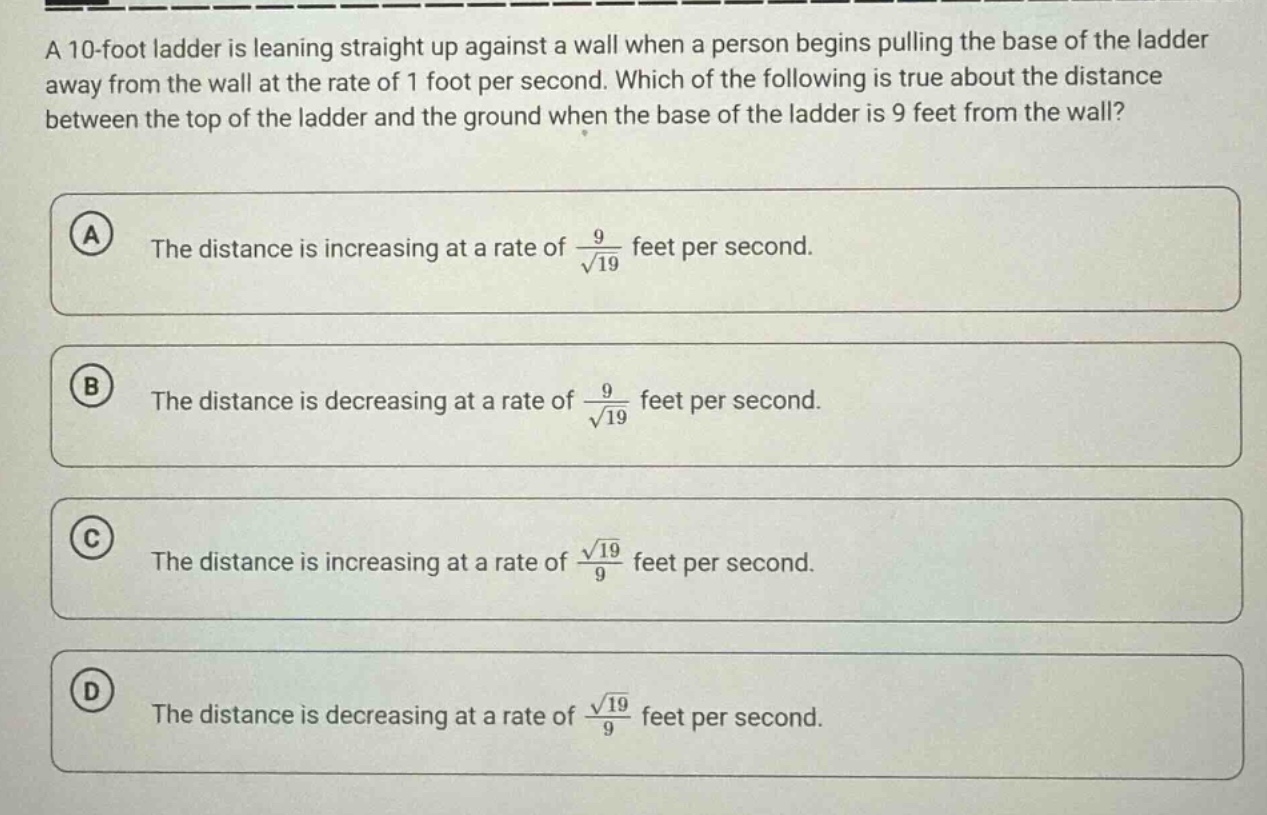
a 10 - foot ladder is leaning straight up against a wall when a person begins pulling the base of the ladder away from the wall at the rate of 1 foot per second. which of the following is true about the distance between the top of the ladder and the ground when the base of the ladder is 9 feet from the wall? a the distance is increasing at a rate of 9 / √19 feet per second. b the distance is decreasing at a rate of 9 / √19 feet per second. c the distance is increasing at a rate of √19 / 9 feet per second. d the distance is decreasing at a rate of √19 / 9 feet per second.
Answer
Explanation:
Step1: Establish the Pythagorean - relation
Let $x$ be the distance between the base of the ladder and the wall, and $y$ be the distance between the top of the ladder and the ground. The length of the ladder $L = 10$ feet. By the Pythagorean theorem, $x^{2}+y^{2}=L^{2}=100$.
Step2: Differentiate with respect to time $t$
Differentiating both sides of the equation $x^{2}+y^{2}=100$ with respect to $t$ gives $2x\frac{dx}{dt}+2y\frac{dy}{dt}=0$. Then we can simplify it to $x\frac{dx}{dt}+y\frac{dy}{dt}=0$.
Step3: Find $y$ when $x = 9$
When $x = 9$, from $x^{2}+y^{2}=100$, we have $y=\sqrt{100 - x^{2}}=\sqrt{100 - 81}=\sqrt{19}$.
Step4: Substitute known values into the differentiated - equation
We know that $\frac{dx}{dt}=1$ foot per second, $x = 9$, and $y=\sqrt{19}$. Substituting these values into $x\frac{dx}{dt}+y\frac{dy}{dt}=0$, we get $9\times1+\sqrt{19}\frac{dy}{dt}=0$.
Step5: Solve for $\frac{dy}{dt}$
Rearranging the equation $9+\sqrt{19}\frac{dy}{dt}=0$ to solve for $\frac{dy}{dt}$, we have $\frac{dy}{dt}=-\frac{9}{\sqrt{19}}$. The negative sign indicates that the distance $y$ is decreasing.
Answer:
B. The distance is decreasing at a rate of $\frac{9}{\sqrt{19}}$ feet per second.