10. the function f has the property that f(x), f(x), and f(x) are negative for all real values x. which of…
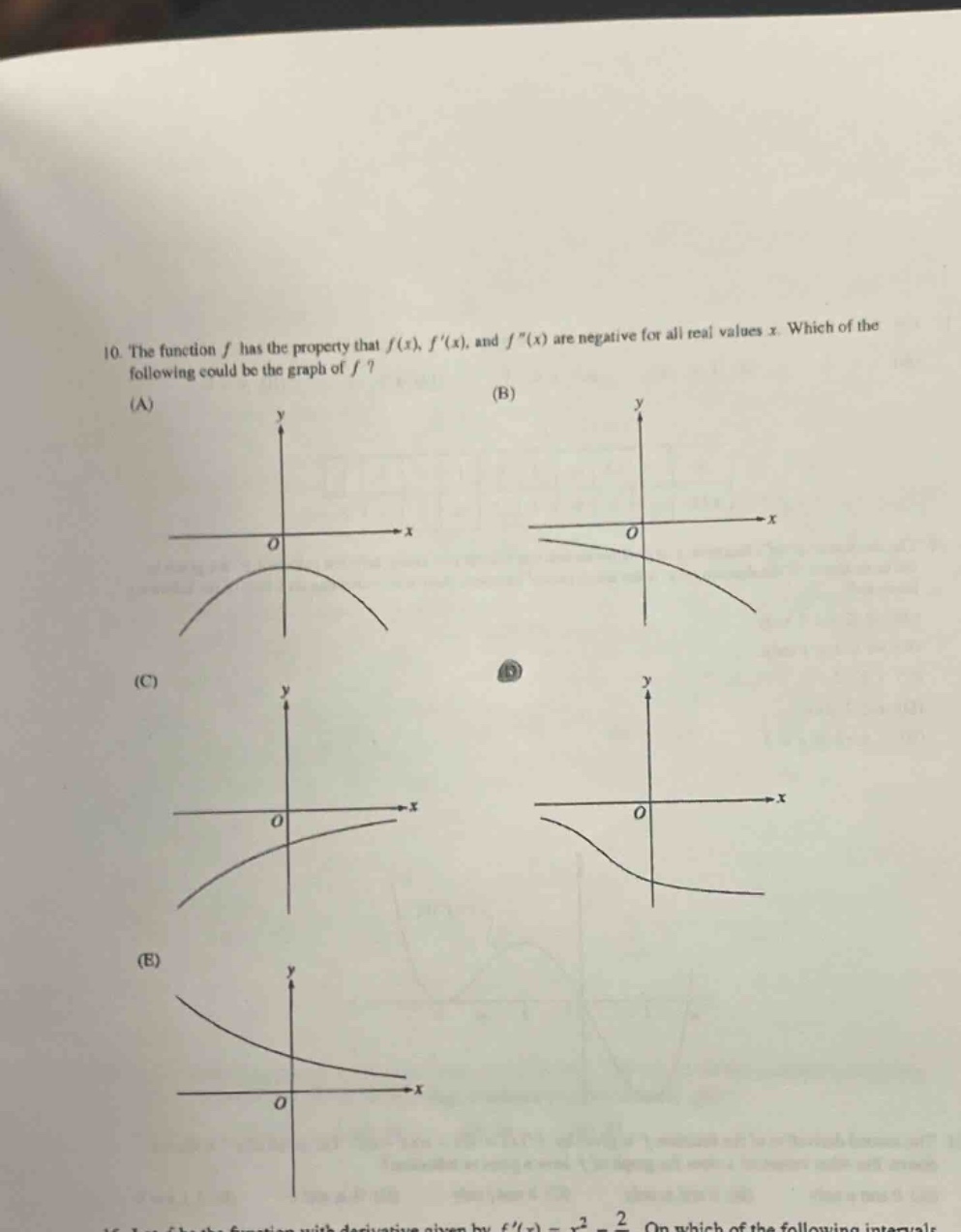
10. the function f has the property that f(x), f(x), and f(x) are negative for all real values x. which of the following could be the graph of f? (a) (b) (c) (d) (e)
Answer
Explanation:
Step1: Analyze function value
Since (f(x)<0) for all real - valued (x), the graph of the function must lie entirely below the (x) - axis. This eliminates options (A) and (C) as they have parts of the graph above the (x) - axis.
Step2: Analyze first - derivative
Since (f^{\prime}(x)<0) for all real (x), the function is decreasing for all real (x). Option (E) is increasing for some values of (x), so it can be eliminated.
Step3: Analyze second - derivative
Since (f^{\prime\prime}(x)<0) for all real (x), the function is concave down for all real (x). Option (D) is concave up for some values of (x), so it can be eliminated.
Answer:
B.