10. which intervals have a negative average rate of change? select all that apply. a. -1, 2 b. 1, 2 c. -1, 3…
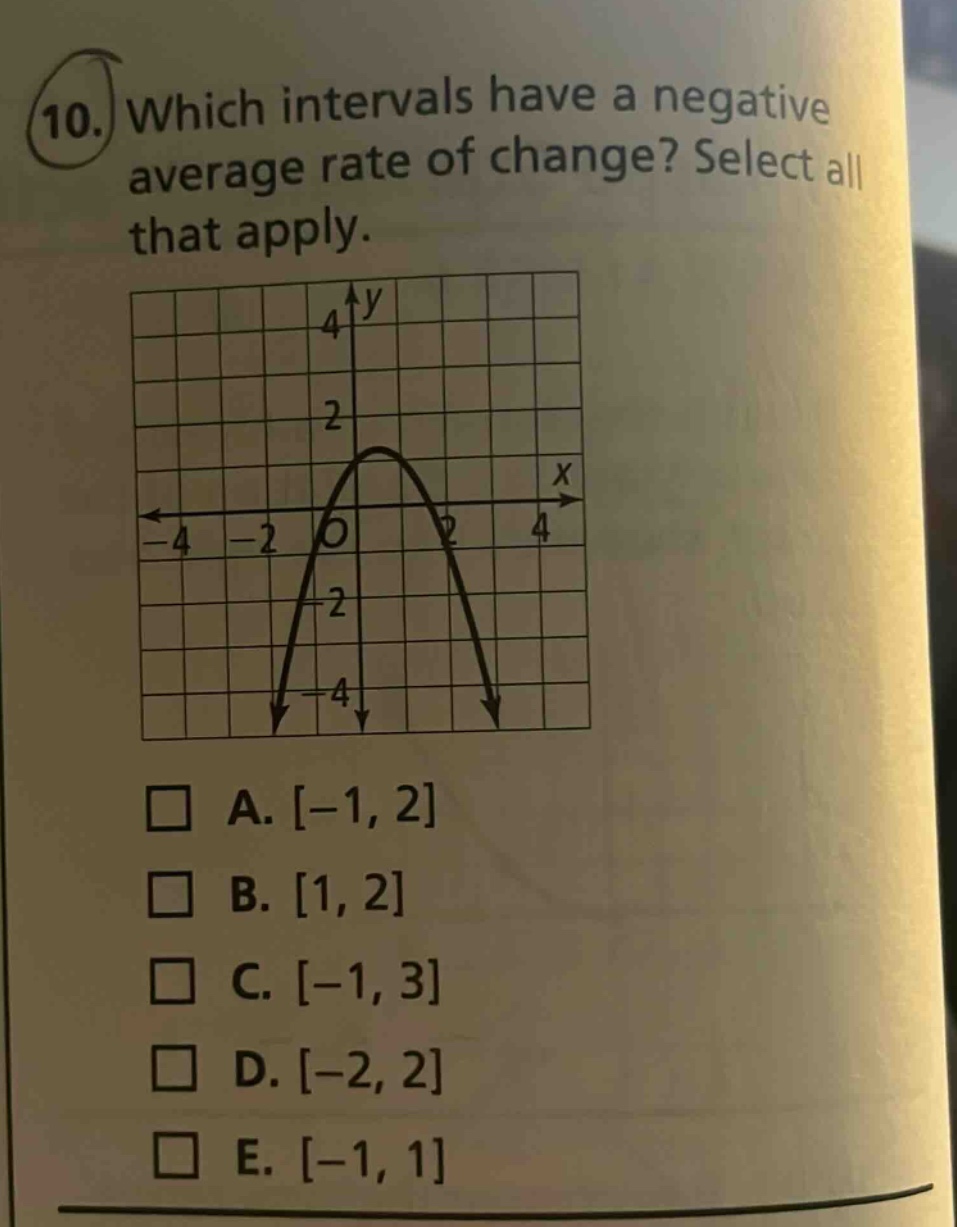
10. which intervals have a negative average rate of change? select all that apply. a. -1, 2 b. 1, 2 c. -1, 3 d. -2, 2 e. -1, 1
Answer
Explanation:
Step1: Recall average - rate - of - change formula
The average rate of change of a function $y = f(x)$ over the interval $[a,b]$ is $\frac{f(b)-f(a)}{b - a}$. If $f(b)-f(a)<0$ (since $b - a>0$ for $b>a$), the average rate of change is negative. This means the function value at the end - point of the interval is less than the function value at the start - point.
Step2: Analyze option A
For the interval $[-1,2]$, from the graph, the function value at $x=-1$ is less than the function value at $x = 2$. So, $\frac{f(2)-f(-1)}{2-(-1)}>0$.
Step3: Analyze option B
For the interval $[1,2]$, from the graph, the function value at $x = 2$ is less than the function value at $x = 1$. So, $\frac{f(2)-f(1)}{2 - 1}=f(2)-f(1)<0$.
Step4: Analyze option C
For the interval $[-1,3]$, the function value at $x = 3$ is less than the function value at $x=-1$. So, $\frac{f(3)-f(-1)}{3-(-1)}<0$.
Step5: Analyze option D
For the interval $[-2,2]$, the function value at $x = 2$ is greater than the function value at $x=-2$. So, $\frac{f(2)-f(-2)}{2-(-2)}>0$.
Step6: Analyze option E
For the interval $[-1,1]$, the function value at $x = 1$ is greater than the function value at $x=-1$. So, $\frac{f(1)-f(-1)}{1-(-1)}>0$.
Answer:
B. $[1,2]$, C. $[-1,3]$