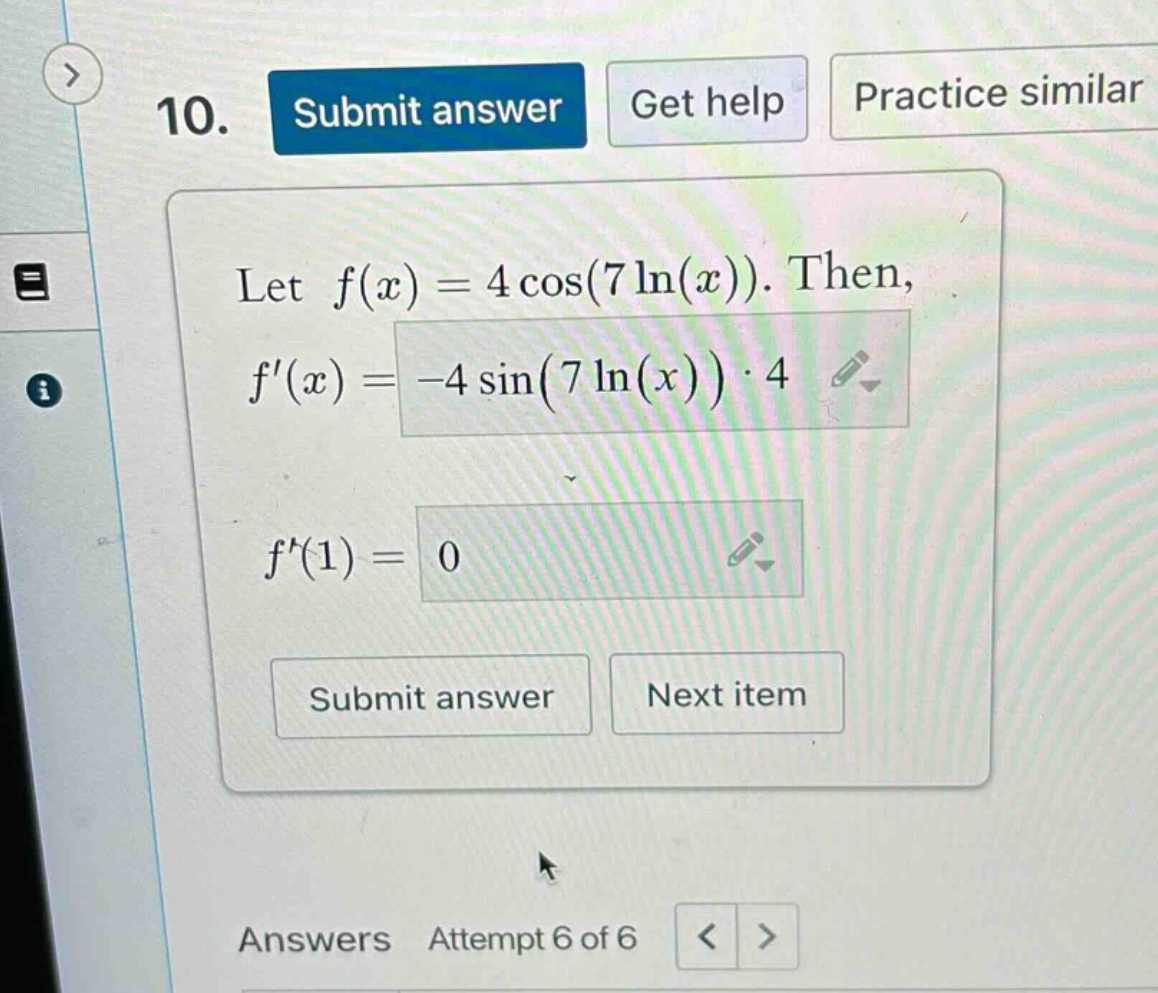
10. let f(x)=4cos(7ln(x)). then, f(x)=-4sin(7ln(x))·4 f(1)=0 answers attempt 6 of 6
10. let f(x)=4cos(7ln(x)). then, f(x)=-4sin(7ln(x))·4 f(1)=0 answers attempt 6 of 6
Answer
Explanation:
Step1: Apply chain - rule
The chain - rule states that if $y = f(g(x))$, then $y'=f'(g(x))\cdot g'(x)$. Let $u = 7\ln(x)$, so $f(x)=4\cos(u)$. The derivative of $\cos(u)$ with respect to $u$ is $-\sin(u)$, and the derivative of $u = 7\ln(x)$ with respect to $x$ is $\frac{7}{x}$. Then $f'(x)=4\times(-\sin(7\ln(x)))\times\frac{7}{x}=-\frac{28\sin(7\ln(x))}{x}$.
Step2: Evaluate $f'(1)$
Substitute $x = 1$ into $f'(x)$. Since $\ln(1)=0$, then $\sin(7\ln(1))=\sin(0) = 0$. So $f'(1)=-\frac{28\sin(7\ln(1))}{1}=0$.
Answer:
$f'(x)=-\frac{28\sin(7\ln(x))}{x}$, $f'(1)=0$