10 mark for review the polar function $r = f(\\theta)$, where $f(\\theta)=1 + 2\\cos\\theta$, is graphed in…
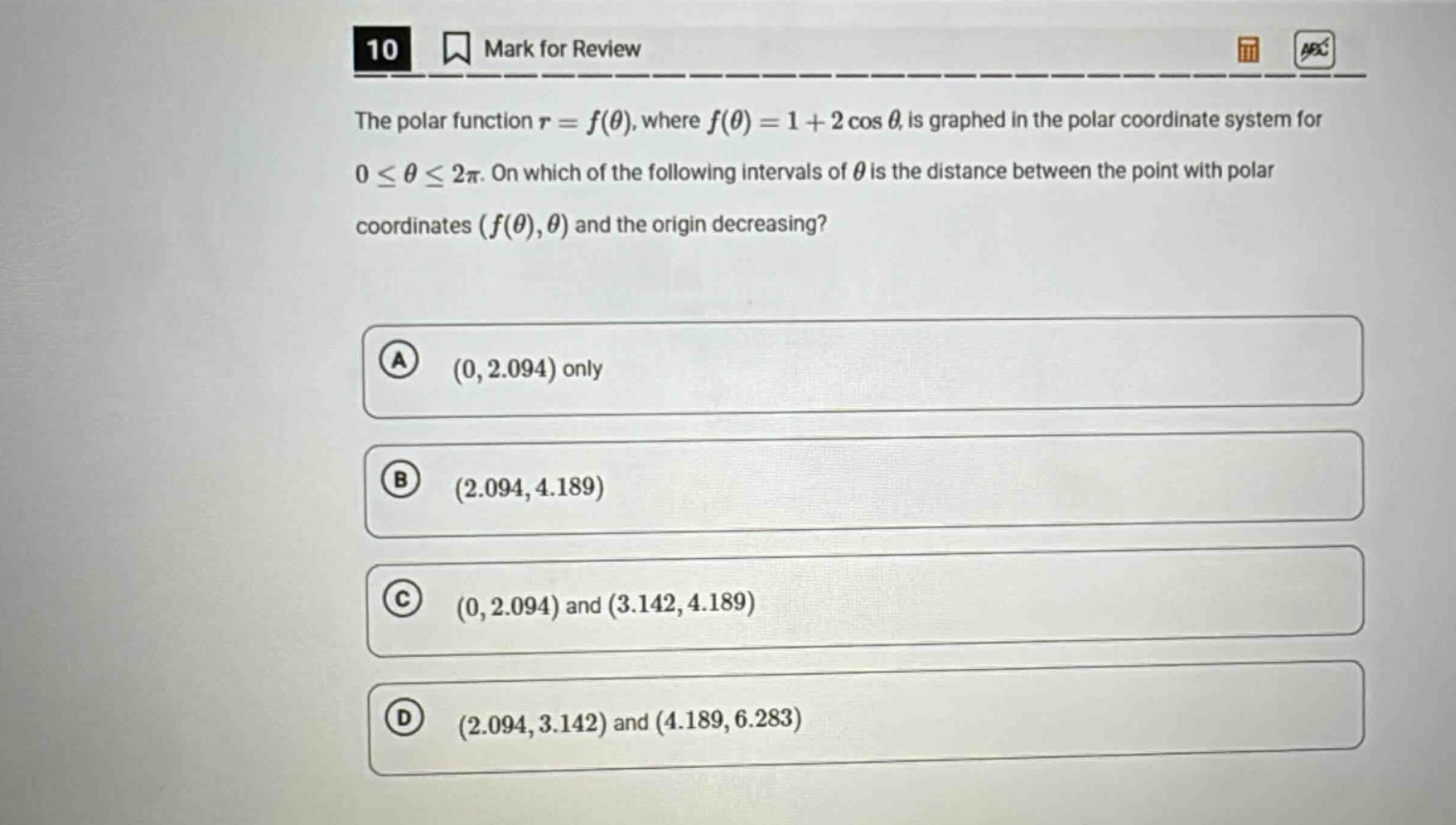
10 mark for review the polar function $r = f(\\theta)$, where $f(\\theta)=1 + 2\\cos\\theta$, is graphed in the polar coordinate system for $0\\leq\\theta\\leq2\\pi$. on which of the following intervals of $\\theta$ is the distance between the point with polar coordinates $(f(\\theta),\\theta)$ and the origin decreasing? (a) $(0,2.094)$ only (b) $(2.094,4.189)$ (c) $(0,2.094)$ and $(3.142,4.189)$ (d) $(2.094,3.142)$ and $(4.189,6.283)$
Answer
Explanation:
Step1: Recall the distance in polar - coordinates
In polar coordinates, the distance between the point $(r,\theta)$ and the origin is given by $r$. Here, $r = f(\theta)=1 + 2\cos\theta$.
Step2: Find the derivative of $r$ with respect to $\theta$
Differentiate $r = 1+2\cos\theta$ with respect to $\theta$. Using the derivative formula $\frac{d}{d\theta}\cos\theta=-\sin\theta$, we get $r'=\frac{dr}{d\theta}=- 2\sin\theta$.
Step3: Determine when $r$ is decreasing
A function $y = r(\theta)$ is decreasing when $r'(\theta)<0$. So we need to solve the inequality $-2\sin\theta<0$, which is equivalent to $\sin\theta>0$. We know that $\sin\theta>0$ for $0 <\theta<\pi$ and $\sin\theta < 0$ for $\pi<\theta<2\pi$. Also, we can find the critical - points of $r = 1 + 2\cos\theta$ by setting $r'=-2\sin\theta = 0$, so $\theta = 0,\pi,2\pi$. We want to find where $r$ is decreasing. Since $r = 1+2\cos\theta$, when $\sin\theta>0$ (i.e., $0<\theta<\pi$), $r$ is decreasing when $\cos\theta$ is decreasing in this interval. The function $r = 1 + 2\cos\theta$ is decreasing when $\sin\theta>0$. The solutions of $\sin\theta>0$ in the interval $[0,2\pi]$ are $0<\theta<\pi$. We can also note that $2.094\approx\frac{2\pi}{3}$ and $4.189\approx\frac{4\pi}{3}$. The function $r = 1 + 2\cos\theta$ is decreasing when $\sin\theta>0$. In the given options, the interval where $r$ is decreasing is $(2.094,4.189)$ because in this interval $\sin\theta>0$ and the derivative of $r = 1+2\cos\theta$ (i.e., $r'=-2\sin\theta$) is negative.
Answer:
B. $(2.094,4.189)$