10. -/1 points details my notes oscat1 8.2.053. how does the period of y = csc(x) compare with the period of…
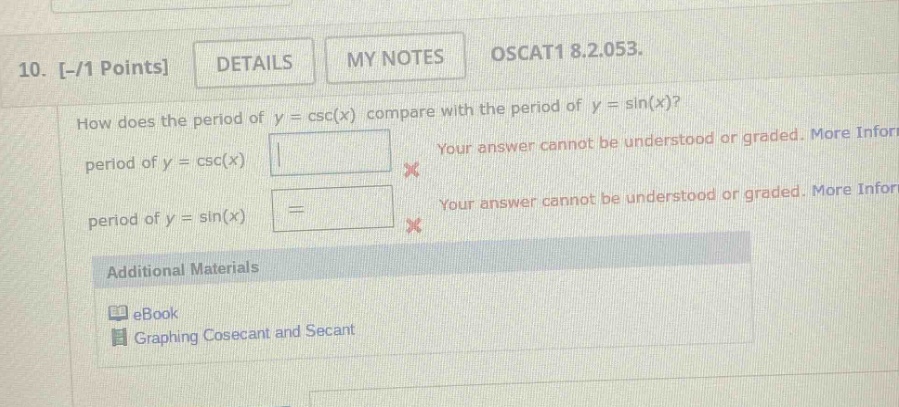
10. -/1 points details my notes oscat1 8.2.053. how does the period of y = csc(x) compare with the period of y = sin(x)? period of y = csc(x) your answer cannot be understood or graded. more infor period of y = sin(x) your answer cannot be understood or graded. more infor additional materials ebook graphing cosecant and secant
Answer
Answer:
period of (y = \csc(x)): (2\pi) period of (y=\sin(x)): (2\pi) The periods are the same.
Explanation:
Step1: Recall period of sine function
The period of (y = \sin(x)) is (2\pi). This is a well - known property of the sine function. The sine function (y=\sin(x)) repeats its values every (2\pi) units, i.e., (\sin(x)=\sin(x + 2\pi)) for all (x).
Step2: Recall relationship between cosecant and sine
We know that (\csc(x)=\frac{1}{\sin(x)}). Since the cosecant function is the reciprocal of the sine function, and the values of (\sin(x)) repeat every (2\pi) units, the values of (\csc(x)) also repeat every (2\pi) units. So the period of (y = \csc(x)) is (2\pi).