8. (10 points) find the amount there will be after 3 years if $100 is invested at 4% interest compounded…
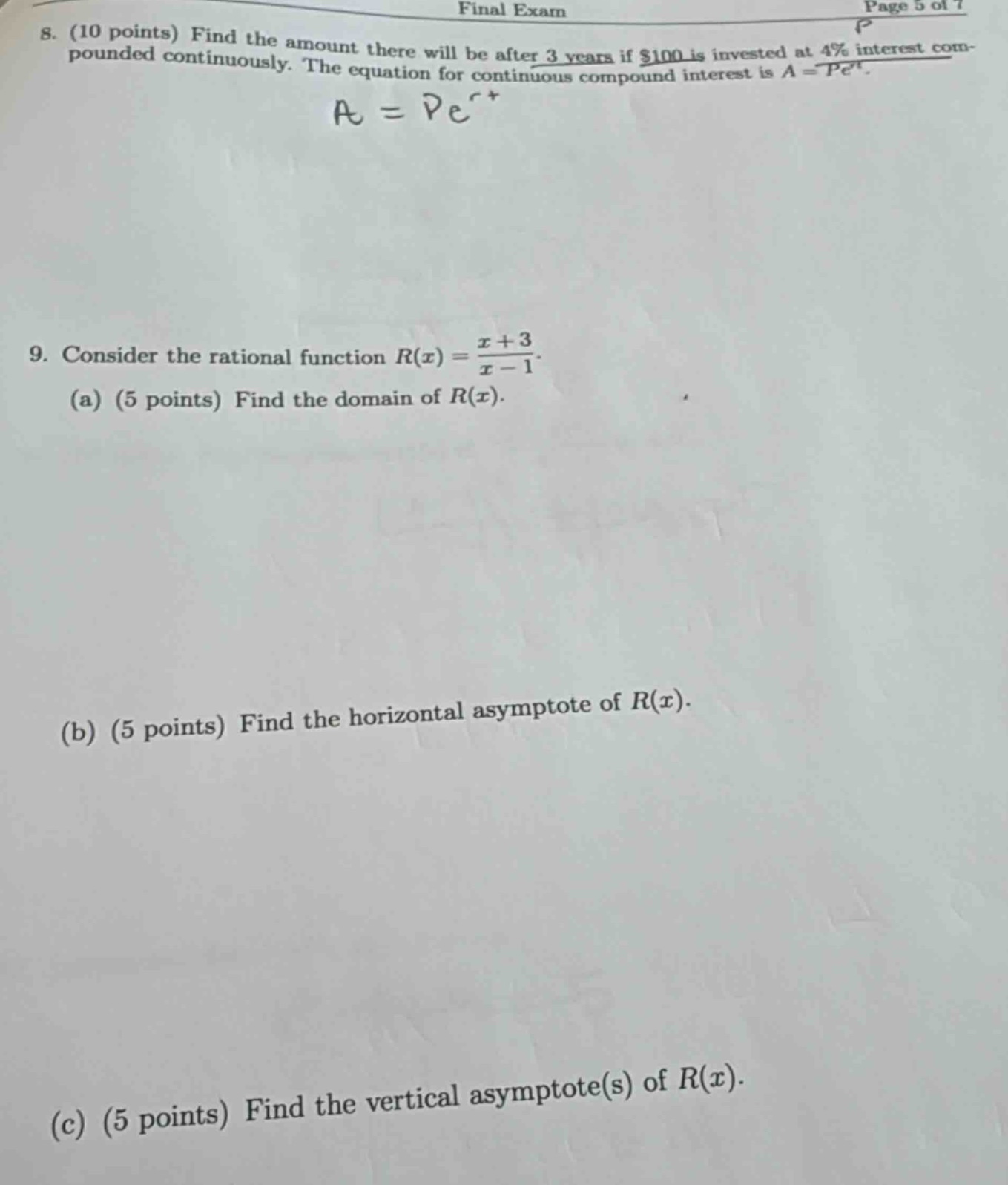
8. (10 points) find the amount there will be after 3 years if $100 is invested at 4% interest compounded continuously. the equation for continuous compound interest is $a = pe^{rt}$. \n9. consider the rational function $r(x)=\\frac{x + 3}{x - 1}$. \n(a) (5 points) find the domain of $r(x)$. \n(b) (5 points) find the horizontal asymptote of $r(x)$. \n(c) (5 points) find the vertical asymptote(s) of $r(x)$.
Answer
Explanation:
Step1: Find the domain
For a rational function (R(x)=\frac{x + 3}{x-1}), the denominator cannot be zero. Set (x - 1=0), then (x = 1). The domain is all real numbers except (x = 1), which can be written in interval notation as ((-\infty,1)\cup(1,\infty)).
Step2: Find the horizontal asymptote
For a rational function (R(x)=\frac{a_nx^n+\cdots+a_0}{b_mx^m+\cdots+b_0}), when (n = m) (here (n=m = 1), (a_n=1), (b_m=1)), the horizontal asymptote is (y=\frac{a_n}{b_m}). So (y = 1).
Step3: Find the vertical asymptote
Set the denominator equal to zero. Since (x-1=0) gives (x = 1), the vertical asymptote is (x = 1).
Answer:
(a) The domain of (R(x)) is ((-\infty,1)\cup(1,\infty)). (b) The horizontal asymptote of (R(x)) is (y = 1). (c) The vertical asymptote of (R(x)) is (x = 1).