10\nselect the correct answer.\nconsider the function ( f(x)=2^{x} ) and function ( g ).\n( g(x)=f(x)+6…
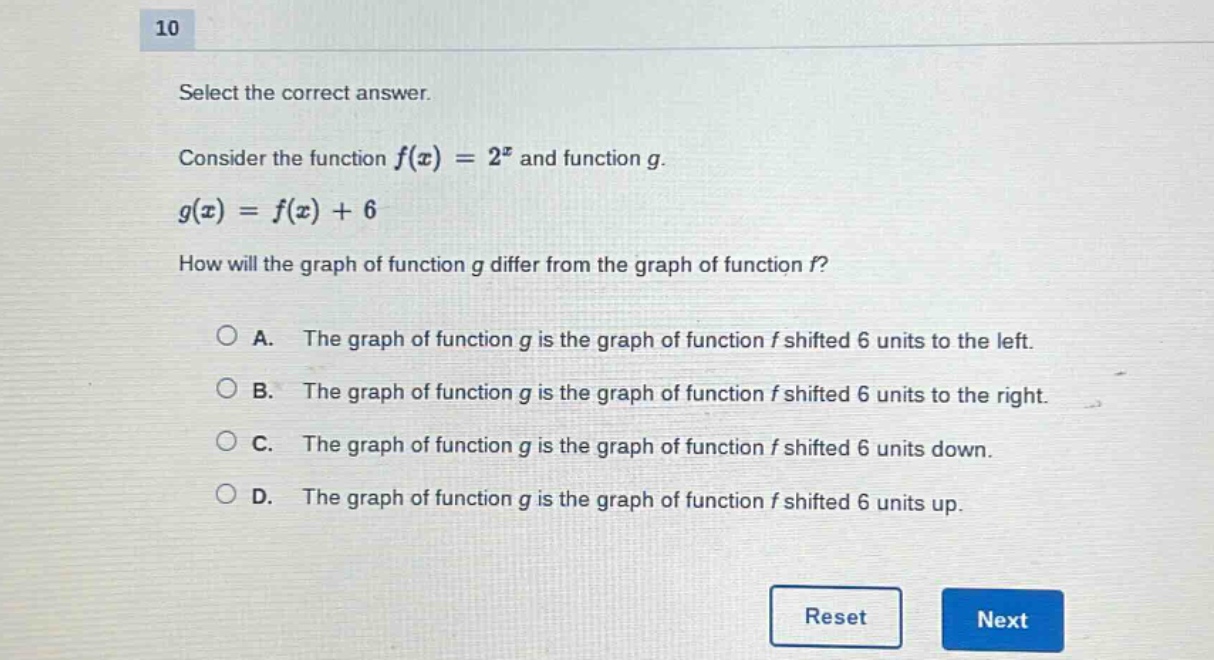
10\nselect the correct answer.\nconsider the function ( f(x)=2^{x} ) and function ( g ).\n( g(x)=f(x)+6 )\nhow will the graph of function ( g ) differ from the graph of function ( f )?\na. the graph of function ( g ) is the graph of function ( f ) shifted 6 units to the left.\nb. the graph of function ( g ) is the graph of function ( f ) shifted 6 units to the right.\nc. the graph of function ( g ) is the graph of function ( f ) shifted 6 units down.\nd. the graph of function ( g ) is the graph of function ( f ) shifted 6 units up.
Answer
Explanation:
Step1: Recall the transformation rule for vertical shift
For a function (y = f(x)+k), if (k>0), the graph of (y = f(x)) is shifted (k) units up. If (k < 0), the graph of (y=f(x)) is shifted (|k|) units down.
Step2: Analyze the given functions
Given (f(x)=2^{x}) and (g(x)=f(x)+6). Here (k = 6>0).
Answer:
D. The graph of function (g) is the graph of function (f) shifted 6 units up.